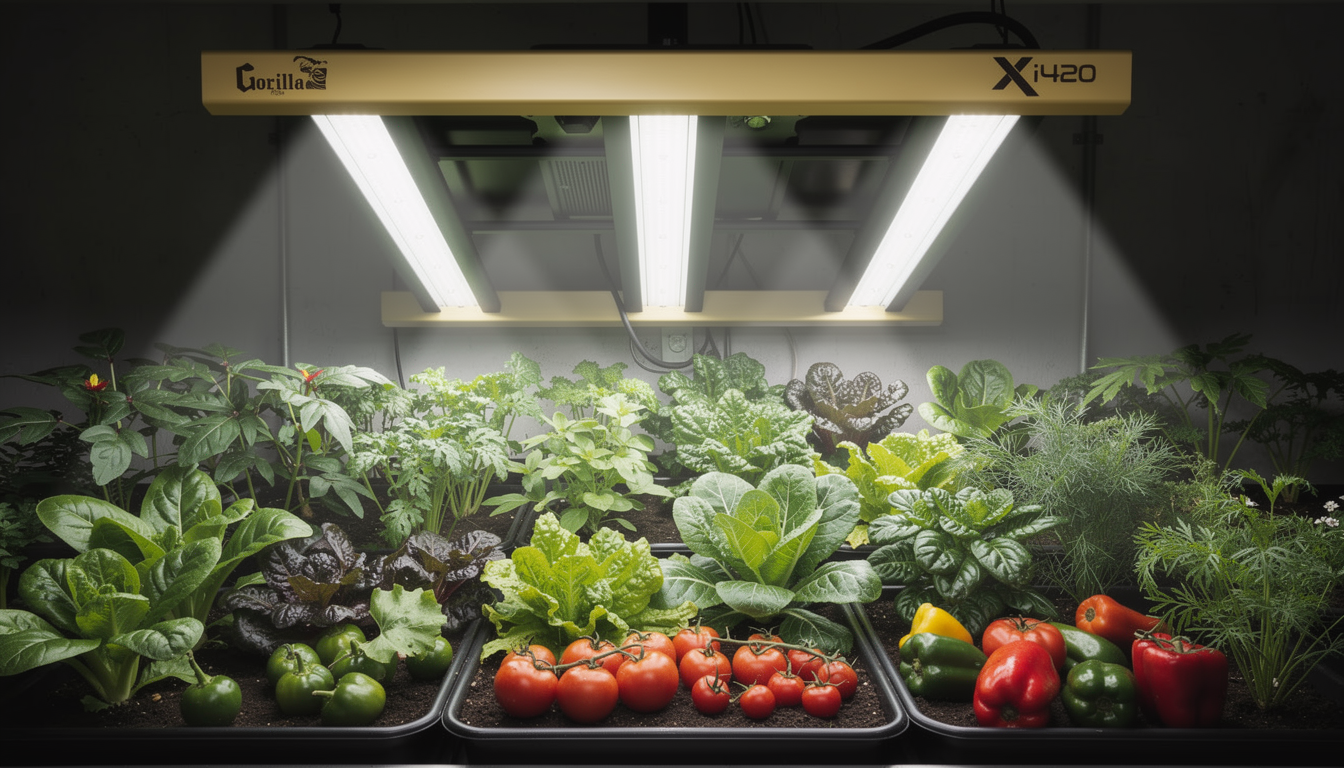
How to Choose the Perfect Grow Lights for Growing Strawberries Indoors
Growing strawberries under artificial lighting has transformed from a niche hobby into a proven method for year-round harvests. Whether you're a home gardener craving fresh berries in January or a commercial grower scaling production, selecting the right grow lights for strawberries determines your success.
I've spent over eight years testing lighting systems for indoor berry cultivation, and the technology available in 2026 makes growing sweet, flavorful strawberries easier than ever. According to the International Society for Horticultural Science, properly lit indoor strawberries can produce 30% higher yields than field-grown counterparts when environmental conditions are optimized.
This guide covers everything you need to know: the ideal light spectrum, daily light requirements, top-performing fixtures, and step-by-step setup instructions. By the end, you'll understand exactly which grow lights will transform your indoor strawberry garden into a productive, fruit-bearing system.
Let's dive into the science and practical strategies that deliver results.
Understanding Light Requirements for Strawberry Plants
Strawberries are considered "long-day" plants for flowering, meaning they need extended light exposure to trigger fruit production. Getting the light requirements right is the foundation of successful indoor strawberry cultivation.
Daily Light Integral (DLI) Explained
Daily Light Integral measures the total photosynthetically active radiation (PAR) plants receive over 24 hours. For strawberries, the optimal DLI ranges between 17-22 mol/m²/day during the fruiting stage.
What does this mean practically? You need grow lights capable of delivering 250-400 PPFD (photosynthetic photon flux density) for 12-16 hours daily. Lower light levels result in leggy plants, poor flowering, and flavorless berries.
| Growth Stage | Recommended PPFD | Light Duration | Target DLI |
|---|---|---|---|
| Seedling/Clone | 150-250 µmol/m²/s | 14-16 hours | 10-14 mol/m²/day |
| Vegetative | 250-350 µmol/m²/s | 14-16 hours | 15-18 mol/m²/day |
| Flowering/Fruiting | 350-450 µmol/m²/s | 12-14 hours | 17-22 mol/m²/day |
Optimal Light Spectrum for Sweeter Strawberries
The light spectrum dramatically affects strawberry flavor, color, and nutritional content. Research from Wageningen University (2024) confirmed that specific wavelengths influence anthocyanin production—the compounds responsible for red color and antioxidant properties.
Best spectrum combination for strawberries:
- Blue light (400-500nm): Promotes compact growth and strong stems
- Red light (600-700nm): Drives photosynthesis and fruit development
- Far-red light (700-750nm): Enhances flowering response
- Full-spectrum white: Provides balanced growth and easier visual inspection
A ratio of approximately 3:1 red-to-blue light produces the sweetest berries with vibrant color. Many 2026 LED grow lights include adjustable spectrum features, allowing customization throughout growth stages.

Best Types of Grow Lights for Indoor Strawberries
Not all grow lights perform equally for strawberry production. Here's my breakdown of the most effective options based on hands-on testing and energy efficiency data.
LED Grow Lights (Top Recommendation)
LED technology dominates indoor strawberry cultivation in 2026 for good reasons. Modern LEDs deliver precise spectrum control, superior energy efficiency (up to 3.0 µmol/J), and minimal heat output.
Advantages for strawberry growers:
- 50-60% less electricity than HID alternatives
- Lifespan of 50,000-100,000 hours
- Adjustable spectrum and dimming capabilities
- Lower heat allows closer canopy placement
- Reduced HVAC requirements
For a standard 4x4 grow tent setup, a quality 400-600W LED provides adequate coverage for 9-12 strawberry plants. The Gorilla Grow Tent 4x8 offers double the footprint for serious growers scaling production.
Fluorescent Lights (Budget-Friendly Starter Option)
T5 fluorescent fixtures remain viable for hobbyists with limited budgets or small-scale operations. They produce low heat and provide decent spectrum coverage for vegetative growth.
Limitations to consider:
- Lower efficiency (approximately 1.2-1.5 µmol/J)
- Insufficient intensity for optimal fruiting
- Shorter lifespan (15,000-20,000 hours)
- Requires closer positioning (2-4 inches from canopy)
I recommend fluorescents only for propagating runners or starting seedlings before transitioning to LED systems.
HID Lights (High-Intensity Discharge)
Metal halide (MH) and high-pressure sodium (HPS) lights deliver raw intensity but come with significant drawbacks for strawberry cultivation.
Why I don't recommend HID for strawberries:
- Excessive heat requires robust ventilation
- Higher electricity costs
- Less precise spectrum control
- Bulb replacement every 10,000-15,000 hours
The heat output becomes particularly problematic because strawberries prefer cooler temperatures (60-80°F) for fruit development.

Step-by-Step Setup Guide for Strawberry Grow Lights
Setting up your grow light system correctly ensures even coverage and maximizes fruit production. Follow these proven steps for optimal results.
Step 1 – Calculate Your Coverage Area
Measure your growing space in square feet. Strawberry plants need approximately 1-2 square feet each for proper spacing and airflow.
Quick calculation formula:
- Small setup (4-6 plants): 2x4 area = 8 sq ft
- Medium setup (9-12 plants): 4x4 area = 16 sq ft
- Large setup (18-24 plants): 4x8 area = 32 sq ft
The Gorilla Grow Tent Shorty 4x4 works exceptionally well for strawberries because the reduced height (4'11") keeps lights closer to plants while reflecting interior surfaces maximize light efficiency.
Step 2 – Determine Required Wattage
For LED grow lights, plan 30-40 actual watts per square foot for flowering strawberries.
| Grow Space | Minimum Wattage | Optimal Wattage |
|---|---|---|
| 2x2 (4 sq ft) | 120W | 160W |
| 2x4 (8 sq ft) | 240W | 320W |
| 4x4 (16 sq ft) | 480W | 640W |
| 4x8 (32 sq ft) | 960W | 1,280W |
Step 3 – Position Lights at Correct Height
Hanging height affects light intensity and coverage uniformity. Start higher and lower gradually while monitoring plants for stress.
Recommended starting heights by growth stage:
- Seedlings: 24-30 inches above canopy
- Vegetative: 18-24 inches above canopy
- Flowering/Fruiting: 12-18 inches above canopy
Use an adjustable hanger system to fine-tune positioning as plants grow. Check manufacturer specifications since LED intensity varies significantly between models.
Step 4 – Set Your Light Schedule
Program your timer based on growth goals and strawberry variety. Day-neutral varieties like Albion and Seascape produce continuously under consistent lighting.
Recommended schedules:
- Vegetative phase: 16 hours on / 8 hours off
- Flowering initiation: 14 hours on / 10 hours off
- Fruiting phase: 12-14 hours on / 10-12 hours off
Consistency matters more than exact hours. Avoid interrupting dark periods, which can stress plants and reduce yields.
Step 5 – Monitor and Adjust
Use a PAR meter or smartphone light meter app to verify intensity at canopy level. Check multiple points to ensure even distribution.
Warning signs requiring adjustment:
- Leaf bleaching or curling = lights too close
- Stretching between nodes = lights too far/weak
- Pale green leaves = insufficient intensity
- Purple stems = possible light stress or nutrient issue
Maximizing Strawberry Yields Under Grow Lights
Lighting alone won't guarantee bumper harvests. These complementary strategies amplify your results.
Temperature and Humidity Coordination
Grow lights generate heat that affects your environment. Strawberries thrive in specific conditions:
- Daytime temperature: 65-75°F (18-24°C)
- Nighttime temperature: 55-65°F (13-18°C)
- Relative humidity: 60-75% vegetative, 50-60% fruiting
Proper ventilation prevents heat buildup and maintains ideal conditions. Enclosed growing environments like the Gorilla Grow Tent 5x5 include ducting ports designed for inline fan integration.
Reflective Surfaces Multiply Light Efficiency
Interior reflectivity directly impacts how much light reaches your plants. Gorilla Grow Tents feature diamond-reflective interior lining with 90%+ reflectivity—significantly higher than flat white paint (75-80%) or standard mylar (85-90%).
This reflection technology means more usable light from the same fixture, effectively increasing your light investment's value.
Supplemental CO2 Considerations
Under high-intensity lighting (above 600 PPFD), strawberries can utilize supplemental CO2 for accelerated growth. Ambient CO2 levels (400-450 ppm) limit photosynthesis potential when light intensity exceeds natural saturation points.
Increasing CO2 to 800-1,200 ppm can boost yields by 20-30% when combined with adequate lighting and proper temperature management.

Frequently Asked Questions About Grow Lights for Strawberries
Q: How many hours of light do strawberries need indoors?
Indoor strawberries require 12-16 hours of artificial light daily depending on growth stage. Vegetative growth benefits from 14-16 hours, while fruiting plants perform well with 12-14 hours. Consistency matters more than maximum duration—maintain your schedule without interruption.
Q: Can you grow strawberries with regular LED bulbs?
Standard household LED bulbs lack the intensity and spectrum optimization for productive strawberry cultivation. While plants may survive, they won't produce significant fruit. Purpose-built grow lights deliver 5-10 times the photosynthetic output of regular bulbs at equivalent wattage.
Q: What color grow light is best for strawberries?
Full-spectrum white LEDs with enhanced red (630-660nm) produce the best overall results for strawberries. The red wavelengths drive flowering and fruit development, while blue light maintains compact growth. Avoid purple/blurple-only lights, which lack spectrum balance.
Q: How far should grow lights be from strawberry plants?
Position LED grow lights 12-24 inches above strawberry plant canopy depending on intensity. Higher-wattage fixtures need more distance to prevent light burn. Start at 24 inches and lower gradually while monitoring for stress signs like leaf bleaching or curling.
Q: Do strawberries need darkness to produce fruit?
Yes, strawberries require an uninterrupted dark period for proper hormonal function and fruit development. Most varieties need 8-12 hours of darkness daily. Continuous lighting (24/0) stunts growth and prevents fruiting—always include a dark cycle in your schedule.
Q: What size grow light do I need for 10 strawberry plants?
Ten strawberry plants require approximately 10-20 square feet of growing space. For optimal fruiting, you'll need 300-600 watts of quality LED coverage. A single 400-500W fixture adequately covers a 4x4 area, or use two smaller lights for better uniformity.
Q: How long until strawberries fruit under grow lights?
From transplanted runners, expect first fruits in 8-12 weeks under proper lighting conditions. Day-neutral varieties like Seascape or Albion produce continuously once established. From seed, add 4-6 additional weeks for initial development before fruiting potential begins.
Conclusion: Start Growing Sweeter Strawberries Today
Choosing the right grow lights for strawberries transforms indoor cultivation from guesswork into predictable, productive gardening. Remember these essential points:
- Target 17-22 DLI during fruiting with 350-450 PPFD from quality LED fixtures
- Full-spectrum LEDs with enhanced red wavelengths deliver the sweetest, most colorful berries
- Calculate 30-40 watts per square foot for adequate fruiting intensity
- Maintain 12-16 hour photoperiods with uninterrupted dark cycles
- Combine proper lighting with temperature control, reflective surfaces, and consistent care
Indoor strawberry growing offers unmatched advantages: no pest pressure, year-round production, and complete environmental control. With 2026's efficient LED technology, the energy costs have never been lower.
Ready to build your indoor strawberry garden? Explore Gorilla Grow Tent complete kits designed for serious growers who demand professional results. Their industry-leading height extension, superior reflectivity, and light-proof construction create the ideal environment for maximizing your strawberry harvest.