What Size Inline Fan for 4x4 Grow Tent? Complete Guide
Are you setting up a 4x4 grow tent and wondering what size inline fan you need? You're not alone. Proper ventilation is crucial for maintaining the ideal growing environment, but choosing the right fan size can be confusing for both beginners and experienced growers. This comprehensive guide will walk you through everything you need to know about selecting the perfect inline fan for your 4x4 grow tent.

Why Proper Ventilation Matters
Before diving into fan sizes, let's understand why ventilation is so important:
- Temperature Control: Prevents overheating from grow lights and equipment
- Humidity Regulation: Reduces excess moisture that can lead to mold and mildew
- CO2 Replenishment: Provides fresh carbon dioxide that plants need for photosynthesis
- Odor Management: When paired with a carbon filter, helps control plant odors
- Air Circulation: Strengthens plant stems and prevents pest infestations
Inadequate ventilation can severely impact plant health and yield, making your inline fan one of the most crucial components of your grow setup.
Understanding CFM (Cubic Feet per Minute)
The most important specification for an inline fan is its CFM rating, which measures airflow capacity. Here's how to calculate the minimum CFM required for your 4x4 grow tent:
Step 1: Calculate Your Tent's Volume
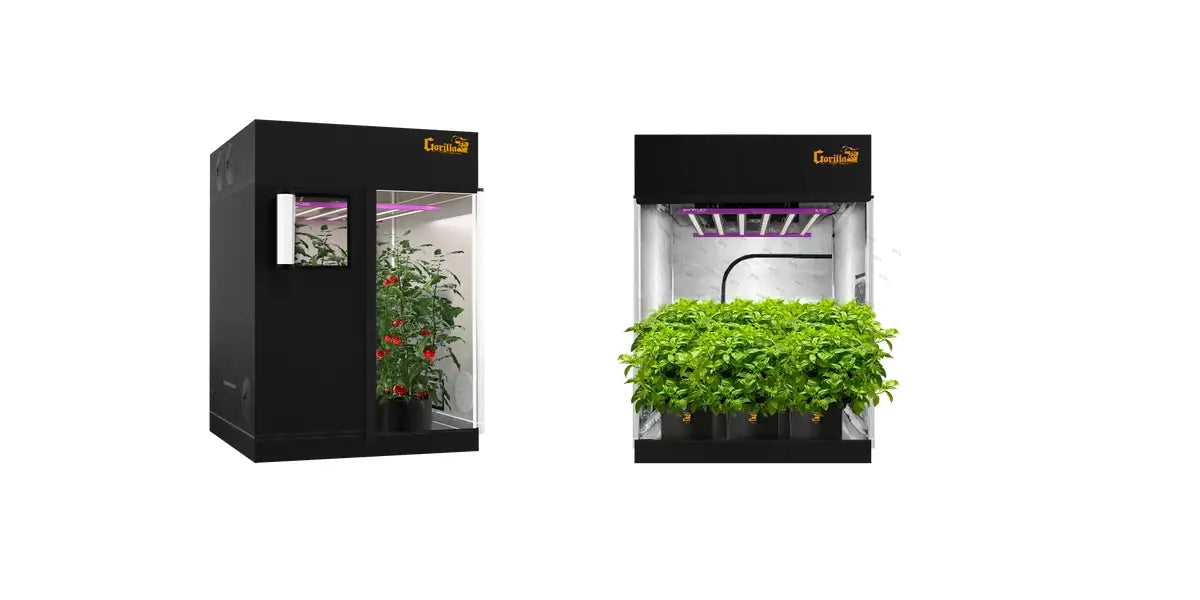
For a standard Gorilla Grow Tent 4x4 with a height of 6'11":
Volume = Length × Width × Height Volume = 4' × 4' × 6.92' Volume = 110.72 cubic feet
Step 2: Determine Base CFM Requirement
As a rule of thumb, you want to exchange all the air in your tent at least once per minute, so your base CFM requirement equals your tent's volume:
Base CFM = 110.72
Step 3: Account for Efficiency Factors
Several factors reduce fan efficiency and require compensation:
- Carbon Filter: Add 25% (multiply by 1.25)
- Ducting: Add 10-20% depending on length and bends (multiply by 1.1-1.2)
- Light Heat: Add 10-50% depending on type and wattage (multiply by 1.1-1.5)
- Silencer (if used): Add 20% (multiply by 1.2)
For example, with a carbon filter, 10 feet of ducting with two bends, and LED lights:
Adjusted CFM = 110.72 × 1.25 × 1.15 × 1.2 Adjusted CFM = 110.72 × 1.725 Adjusted CFM ≈ 191 CFM
Step 4: Add Safety Margin
To ensure your fan isn't constantly running at maximum capacity (which increases noise and reduces fan life), add 25%:
Final CFM = 191 × 1.25 Final CFM ≈ 239 CFM
Recommended Inline Fan Sizes for 4x4 Grow Tents
Based on these calculations and real-world performance, here are the recommended fan sizes for a 4x4 grow tent:
6-Inch Inline Fan (250-350 CFM)
- Best choice for most 4x4 grow tents
- Provides sufficient airflow even with filters and moderate ducting
- Balances airflow needs with noise levels
- Great for LED lighting setups
- Recommended product: Gorilla GXi 6 - Wireless Intelligent Inline Fan
4-Inch Inline Fan (100-205 CFM)
- May be sufficient for minimal setups (single small LED, short ducting, no filter)
- Will likely need to run at maximum capacity
- Better suited for 2x2 or 3x3 tents
- Consider if noise is a primary concern
- Recommended product: Gorilla GXi 4 - Wireless Intelligent Inline Fan
8-Inch Inline Fan (400-800 CFM)
- Best for high-heat situations (HID lighting, multiple lights)
- Recommended for CO2-enriched environments
- Provides extra capacity for longer/complex ducting runs
- Overkill for most standard 4x4 setups but provides future flexibility
Common Ventilation Setups for 4x4 Grow Tents
Passive Intake Setup (Most Common)
- 6-inch exhaust fan + carbon filter at the top of the tent
- Open passive intake vents at the bottom for fresh air
- Simple and effective for most 4x4 grow scenarios
Active Intake Setup
- 6-inch exhaust fan + carbon filter at the top
- 4-inch intake fan at the bottom (running at lower speed)
- Creates better controlled airflow
- Useful for sealed tents or high-temperature environments
Sealed Environment (Advanced)
- 6-8 inch exhaust fan + carbon filter
- Equivalent or slightly smaller intake fan
- CO2 supplementation
- Requires more precise control and monitoring
Tips for Optimal Ventilation Performance
- Position your exhaust at the highest point in your tent since heat naturally rises
- Keep ducting runs as short and straight as possible to minimize efficiency losses
- Use a fan speed controller to adjust airflow based on temperature/humidity needs
- Consider a smart fan with temperature/humidity sensors like the Gorilla GXi series for automated control
- Install a circulation fan inside the tent to improve air movement around plants
- Use the High CFM Kit from Gorilla Grow Tent if your tent walls are being pulled inward from negative pressure
Common Ventilation Issues and Solutions
Problem: Tent Walls Sucking In
Solution: Your fan is creating too much negative pressure. Either reduce fan speed, add more intake openings, or install Gorilla's High CFM Kit support bars.
Problem: High Humidity
Solution: Increase exhaust fan speed to remove more moist air, and consider adding a dehumidifier for severe cases.
Problem: Temperature Too High
Solution: Ensure proper exhaust placement at the top of the tent, increase fan speed, and consider upgrading to a larger fan if persistent.
Problem: Excessive Noise
Solution: Use a fan speed controller to run at lower speeds when possible, add a silencer, or upgrade to a quieter model like the Gorilla GXi series.
Conclusion
For most 4x4 grow tents, a 6-inch inline fan with a CFM rating of 250-350 is the optimal choice, providing enough airflow capacity for effective ventilation while maintaining reasonable noise levels. The Gorilla GXi 6 - Wireless Intelligent Inline Fan is an excellent option that features wireless control, temperature and humidity sensors, and quiet operation.
Remember that proper ventilation is essential for successful indoor growing. Investing in a quality inline fan with the right CFM rating will help create the optimal environment for your plants to thrive.