


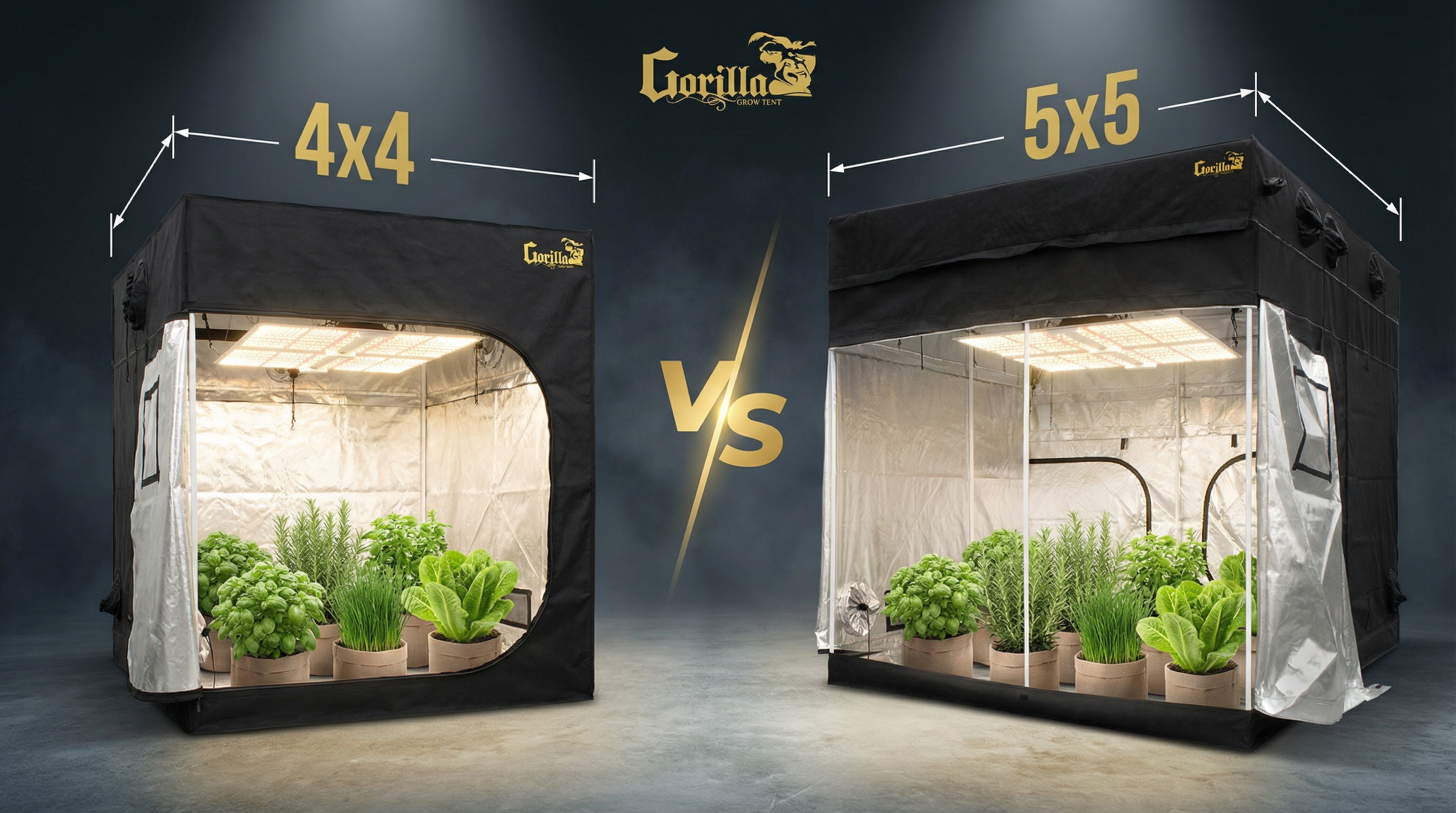
4x4 vs 5x5 Grow Tent: Which Size Should You Buy in 2026?
A 4x4 grow tent (16 sq ft) is the right pick if you're growing 1–4 plants, have a spare closet or corner, and want lower equipment and electricity costs. A 5x5 grow tent (25 sq ft) gives you 56% more canopy for 4–6 plants, needs a dedicated room, and only costs about $30 more up front — but doubles fan, filter, and light requirements.
If your room can fit a 5x5 and your electric panel can handle the larger light, buy the 5x5 — you'll never outgrow it. If you're space- or budget-constrained, the 4x4 is the best starter footprint in home growing.
Choosing between a 4x4 grow tent and a 5x5 grow tent is the single biggest decision you'll make as an indoor grower — it dictates your plant count, light wattage, airflow requirements, electricity bill, and how much of your home you dedicate to growing. Get it right and your setup runs efficiently for years. Get it wrong and you either run out of canopy in month two or spend 40% more than you needed to on equipment.
This guide compares the Gorilla Grow Tent Pro 4x4 and Pro 5x5 head-to-head across every decision factor that matters: footprint, height, yield potential, equipment sizing, total cost of ownership, and room-fit constraints. Both tents use the same 1680D canvas, 22mm cold-rolled steel frame, and patented height-adjustable extension kits — the only variable is footprint.
On This Page
- Side-by-Side: 4x4 vs 5x5 Pro
- Full Spec Comparison Table
- Yield & Plant Count by Size
- Vertical Clearance: The Gorilla Advantage
- Equipment Sizing: Fan, Filter, Dehumidifier, Light
- Room Size Requirements
- Total Cost of Ownership
- When to Pick 4x4 vs 5x5
- Recommended Configurations
- Frequently Asked Questions
Side-by-Side: Gorilla Grow Tent Pro 4x4 vs Pro 5x5
Gorilla Grow Tent Pro 4x4
$319.95 · tent only- 48" × 48" × 83" footprint (16 sq ft)
- 1680D canvas · 22mm steel frame
- Fits 1–4 plants, 300–600W LED
- Ideal for closets, spare rooms, corners
- Lower airflow & electrical demand
Gorilla Grow Tent Pro 5x5
$349.95 · tent only- 60" × 60" × 83" footprint (25 sq ft)
- 1680D canvas · 22mm steel frame
- Fits 4–6 plants, 600–800W LED
- Best for dedicated grow rooms
- +56% canopy for +$30
The price difference between the Pro 4x4 and Pro 5x5 is roughly $30, but the 5x5 adds 9 square feet of canopy — that's the cheapest growing square footage you'll ever buy. The real cost of going up to a 5x5 isn't the tent — it's the larger LED, bigger fan, and extra carbon filter capacity you'll also need.
Full Spec Comparison Table
| Spec | Pro 4x4 | Pro 5x5 |
|---|---|---|
| Footprint | 48" × 48" | 60" × 60" |
| Canopy area | 16 sq ft | 25 sq ft (+56%) |
| Base height | 6'11" | 6'11" |
| With 1-ft extension kit (included) | 7'11" | 7'11" |
| With 2-ft extension kit (optional) | 8'11" | 8'11" |
| Internal volume (with 1-ft extension) | 127 cu ft | 198 cu ft |
| Canvas | 1680D | 1680D |
| Frame | 22mm cold-rolled steel | 22mm cold-rolled steel |
| Interior lining | Diamond reflective | Diamond reflective |
| Ducting ports | Multiple 11" double-cinching | Six 11" double-cinching |
| Plant capacity (typical) | 1–4 | 4–6 |
| Recommended LED wattage | 300–600W | 600–800W |
| Exhaust fan (min CFM) | 170–200 CFM | 300–400 CFM |
| Carbon filter size | 4"–6" | 6"–8" |
| Dehumidifier capacity | 30–50 pint | 50–70 pint |
| Minimum room footprint | ~5' × 5' | ~6' × 6' |
| Minimum room ceiling | 7'2" | 7'2" |
| Tent-only price | $319.95 | $349.95 |
Yield & Plant Count: What Fits in Each Size?
Plant count is the #1 reason growers size up or down. Using standard Sea of Green (SOG), Screen of Green (ScrOG), or topped plant methods, here's what realistically fits inside each tent without crowding:
| Method | Pro 4x4 | Pro 5x5 |
|---|---|---|
| Single large plant (topped/trained) | 1 plant (fills canopy) | 1 plant (with room to spare) |
| SOG (Sea of Green) | 9–16 small plants | 16–25 small plants |
| ScrOG (Screen of Green) | 2–4 trained plants | 4–6 trained plants |
| Hydroponic Super Flow | 12 sites | 20 sites |
| Hydroponic Bubble Flow Buckets | 6 sites | 6 sites (more head space per plant) |
If you're growing fewer than 4 plants and don't plan to scale, the 4x4 is more efficient. If you're running 4 or more plants or want the option to add later, 5x5 pays for itself within the first harvest through higher yield per hour of effort.
Vertical Clearance: The Gorilla Advantage
Most 4x4 and 5x5 tents on the market top out at 6'7" to 6'11" — fine for compact strains and short LEDs, but a problem the moment you add a scrubber filter, height-adjustable lights, or tall plants. Both the Pro 4x4 and Pro 5x5 ship with a 1-foot extension kit included — free, in the box — which raises max height to 7'11".
An optional 2-foot extension kit (sold separately) pushes maximum interior height to 8'11". That's a full two feet of additional vertical clearance you simply cannot get from AC Infinity, Spider Farmer, Mars Hydro, or any other brand — Gorilla Grow Tent holds the patent on height-adjustable tent technology.
Every 12 inches of extra ceiling gives you: one full extra inch of LED hanging distance, room for an inline carbon filter above the canopy (instead of in the airspace), and space for plants to stretch in late veg without light-burn. Growers who "outgrow" their tent usually run out of height, not floor space.
Equipment Sizing: Fan, Filter, Dehumidifier, Light
The tent is one-third of your setup. Here's what you actually need to run a 4x4 or 5x5 properly — sizing rules are based on tent volume and one complete air exchange per minute, plus 25–50% headroom for carbon filter resistance.
What Size Exhaust Fan for a 4x4 Grow Tent?
A 4x4 tent at base height is 112 cu ft (16 sq ft × 7 ft). With a carbon filter inline, the static pressure loss requires 170–200 CFM minimum. A 4-inch or 6-inch variable-speed inline duct fan is the right match. Our Smart Inline Duct Fans auto-ramp when humidity or temperature drifts, so the tent self-regulates.
What Size Exhaust Fan for a 5x5 Grow Tent?
A 5x5 tent at base height is 175 cu ft (25 sq ft × 7 ft). With a filter inline you want 300–400 CFM — step up to a 6-inch fan or run a larger 8-inch model at half speed for lower noise.
Carbon Filter Sizing
| Tent | Filter Size | Why |
|---|---|---|
| 4x4 | 4" × 12" or 6" × 16" | Matches 4"/6" fan, filters 170–200 CFM |
| 5x5 | 6" × 20" or 8" × 24" | Larger surface area for higher CFM, lower speed |
What Size Dehumidifier for a 4x4 Grow Tent?
In flower, a 4x4 produces roughly 1.5–2.5 gallons of water vapor per day. A 30–50 pint dehumidifier placed in the surrounding room (not inside the tent) handles this comfortably. Pair it with the GXi WiFi Temp & Humidity Sensor to keep RH targets in the correct VPD band for each growth stage.
What Size Dehumidifier for a 5x5 Grow Tent?
A 5x5 pushes 3–4 gallons of vapor per day in peak flower — size up to a 50–70 pint unit in the room.
LED Grow Light Wattage
| Tent | Recommended LED | Actual Wattage | PPFD Target |
|---|---|---|---|
| 4x4 | GXi Xi-220 or Xi-330 | 220–330W | 700–900 µmol/m²/s at canopy |
| 5x5 | GXi Xi-330 or Xi-420 | 330–420W | 700–900 µmol/m²/s at canopy |
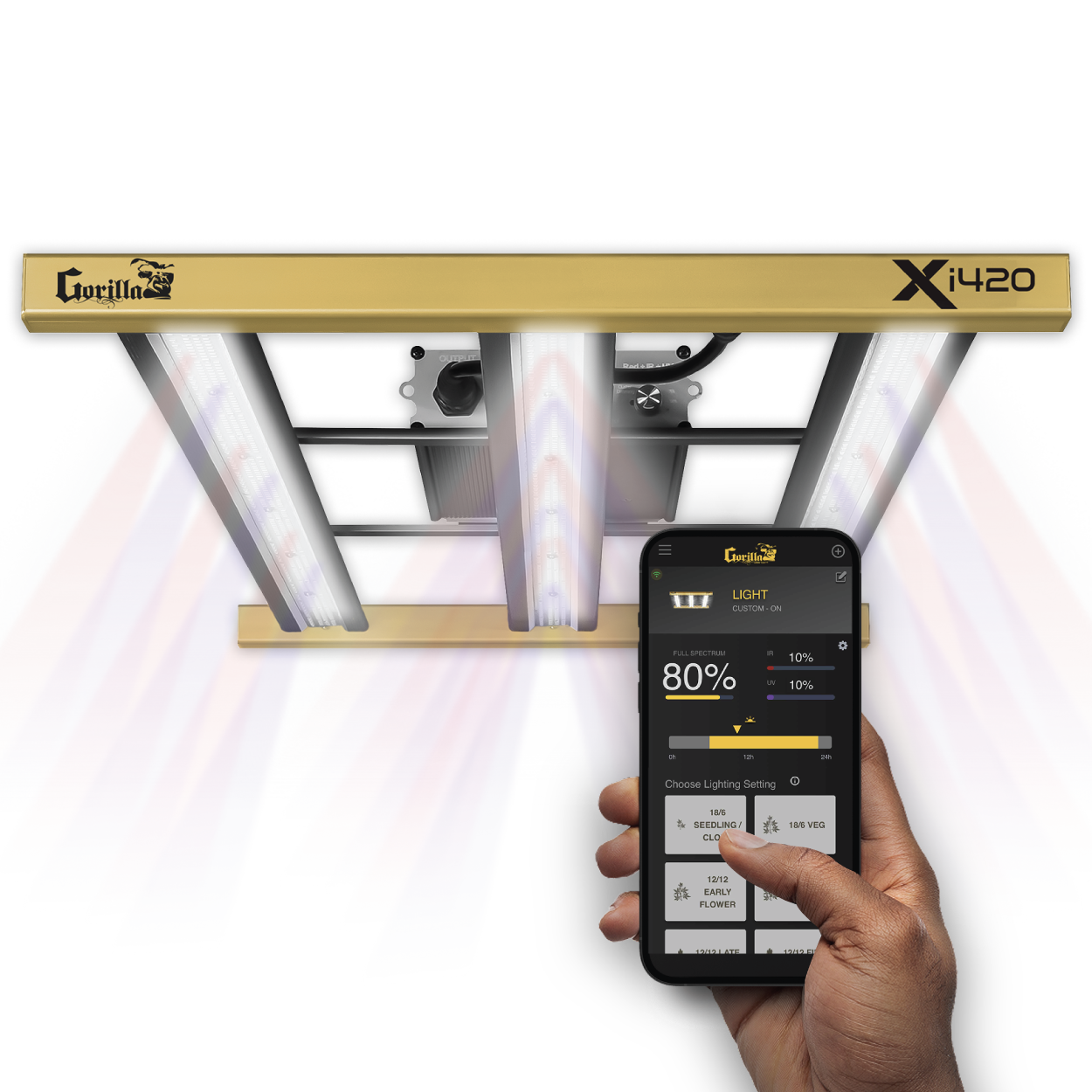
See the full GXi Xi-Series LED lineup — all models are dimmable via the Gorilla Grow Tent App and tri-channel spectrum-tunable.
Room Size Requirements
A 4x4 footprint tent doesn't fit in a 4x4 room — you need at least 12 inches of clearance on all sides for doors, ducting, and maintenance access. Here's the real-world room math:
| Tent | Tent Footprint | Minimum Room | Ceiling Required (with 1-ft ext) |
|---|---|---|---|
| Pro 4x4 | 48" × 48" | 72" × 72" (6' × 6') | 8' |
| Pro 5x5 | 60" × 60" | 84" × 84" (7' × 7') | 8' |
A 5x5 tent standing at 7'11" needs an 8-foot ceiling to set up the frame without angling it. Measure your room ceiling at its lowest point (check for ceiling fans, HVAC ducts, or sloped ceilings). If you have a 7'6" ceiling, plan for base height only (6'11") and skip the extension kit.
Total Cost of Ownership: Tent + Equipment
The tent price is the first 20% of your build. Here's what a complete setup costs at each size — tent + LED + fan + filter + sensor:
| Component | Pro 4x4 Build | Pro 5x5 Build |
|---|---|---|
| Tent | $319.95 | $349.95 |
| GXi LED (Xi-220 / Xi-330) | ~$399 | ~$549 |
| Smart Inline Duct Fan + Filter | ~$249 | ~$349 |
| GXi WiFi Temp/Humidity Sensor | $99 | $99 |
| Component total (DIY) | ~$1,067 | ~$1,347 |
| — or — | ||
| 4x4 Soil Grow Room Kit (bundled) | $1,549.95 | — |
| 4x4 Hydroponic Bubble Flow Kit | $1,795.95 | — |
| 5x5 Soil Grow Room Kit (bundled) | — | $1,795.95 |
| 5x5 Hydroponic Bubble Flow Kit | — | $2,095.99 |
Bundled kits add $480–$750 over DIY but include guaranteed component compatibility, shared shipping, and a Gorilla warranty across the whole system. For first-time growers, the complete grow tent kits are the safer buy.
When to Pick 4x4 vs 5x5
Pick the Pro 4x4 if…
- You're growing 1–4 plants and won't scale
- Your space is a spare closet, corner, or half of a spare room
- Your electric panel is older (100-amp service, shared circuits)
- You want to keep monthly electricity under $60
- You're a first-time grower testing the hobby
- You have a 6'–7' room footprint available
Pick the Pro 5x5 if…
- You're growing 4+ plants or plan to scale
- You have a dedicated grow room (basement, garage, spare room)
- Your electric panel can handle a 600W+ LED
- You want maximum yield per hour of maintenance
- You're upgrading from a 2x4 or 3x3 tent
- You have 7'+ of floor clearance and 8'+ ceiling
If you can fit a 5x5 and afford the larger LED, buy the 5x5. The tent itself is only $30 more and you'll rarely regret having extra canopy. Growers who go 4x4 with the intent to "upgrade later" often end up running two tents — which costs more than starting with one 5x5.
Recommended Configurations
Complete 4x4 & 5x5 Builds
Bundled kits with tent, LED, fan, filter, and accessories — compatibility guaranteed.
Frequently Asked Questions
Is a 5x5 grow tent worth it over a 4x4?
Yes if you have the room and a 600W+ LED budget — you get 56% more canopy for only $30 more on the tent itself. No if your room is tight or you're running a first grow; start with 4x4 and master the environment before scaling.
What size fan do I need for a 4x4 grow tent?
At minimum 170–200 CFM with a carbon filter inline. A 4-inch or 6-inch variable-speed smart inline duct fan is the correct match. Size up by 25–50% over tent volume to account for filter resistance.
What size fan do I need for a 5x5 grow tent?
300–400 CFM. A 6-inch smart inline fan handles a 5x5 comfortably; an 8-inch fan run at half speed is quieter and extends filter life.
What size carbon filter for a 4x4 grow tent?
A 4" × 12" or 6" × 16" carbon filter is correct for a 4x4. Match the filter diameter to your fan diameter; a longer filter (more carbon) extends replacement intervals.
What size carbon filter for a 5x5 grow tent?
A 6" × 20" or 8" × 24" carbon filter. Larger filters allow you to run the fan at lower speed for the same air cleaning — quieter, longer life.
What size dehumidifier for a 4x4 grow tent?
A 30–50 pint dehumidifier placed in the surrounding room, not inside the tent. In flower, a 4x4 produces 1.5–2.5 gallons of water vapor per day.
What size dehumidifier for a 5x5 grow tent?
A 50–70 pint dehumidifier. A 5x5 produces 3–4 gallons of water vapor per day in peak flower, so size up accordingly.
How many plants fit in a 4x4 grow tent?
Typically 1–4 plants: one large topped plant, 2–4 ScrOG-trained plants, 9–16 SOG small plants, or 6-site hydroponic buckets. Crowding past 4 large plants reduces yield per plant.
How many plants fit in a 5x5 grow tent?
Typically 4–6 plants: 4–6 ScrOG plants, 16–25 SOG, or 20-site Super Flow hydroponic systems.
How tall is the Gorilla Grow Tent Pro 4x4 and 5x5?
Both ship at 6'11" base height with a 1-foot extension kit included (extends to 7'11"). An optional 2-foot extension kit sold separately pushes either tent to 8'11" — patented height-adjustable technology unique to Gorilla Grow Tent.
Can I fit a 5x5 tent in a spare bedroom?
Yes if the room is at least 7' × 7' with an 8-foot ceiling. Leave 12" of clearance on all sides for ducting and maintenance access. Measure the lowest point on your ceiling — fans, ducts, or slopes count.
Related Guides
Learn more: VPD Chart for Grow Tents · How to Bring Humidity Down in a Grow Tent · Grow Room Temp & Humidity Chart
Ready to Pick Your Tent?
Both the Pro 4x4 and Pro 5x5 ship with the same premium canvas, frame, and extension kit. Pick your footprint, add the right LED and fan, and you're done.
%20is%20the%20right%20pick%20if%20you're%20growing%201%E2%80%934%20plants,%20have%20a%20...)