Leggy Seedlings: How to Fix, Prevent, and Save Them
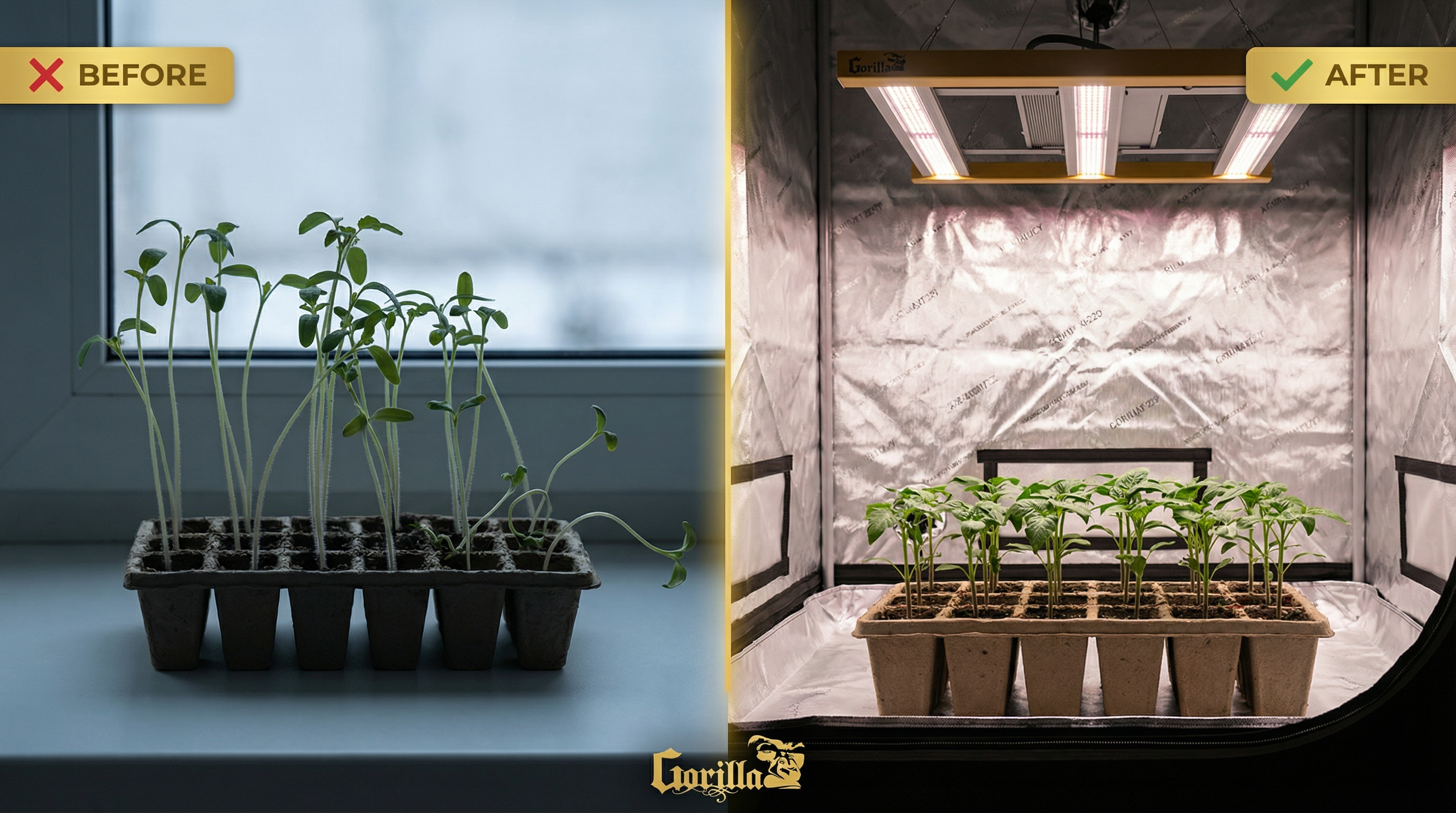
Leggy seedlings are young plants with thin, stretched stems and wide gaps between leaf sets — the result of too little light. They lean, flop over, and snap easily because the plant is racing upward looking for the sun it can't find.
Fix leggy seedlings in 3 steps: (1) move them under a full-spectrum LED within 12–18 inches of the leaves, (2) add gentle airflow to strengthen the stems, and (3) transplant deeper so buried stem sections grow new roots. Prevent it by giving seedlings 14–16 hours of direct LED light from day one — a sunny windowsill is rarely enough in winter.
If your tomato, pepper, broccoli, basil, or lettuce seedlings are tall, floppy, and pale instead of short, stocky, and green — they're leggy. This is the single most common problem in indoor seed starting, and almost always traces back to light. The good news: leggy seedlings are recoverable if caught early. The better news: a $250 LED and a 2x2 grow tent prevents the problem entirely for every future season of seed starting.
This guide explains what leggy seedlings are, why they happen, how to fix them, and — most importantly — how to set up a seed-starting station that produces short, strong, dark-green seedlings every time.
On This Page
What Are Leggy Seedlings?
A healthy seedling has a short, thick stem (sometimes called "stocky"), close-spaced leaves, and a dark green color. A leggy seedling has the opposite: a thin, elongated stem with stretched gaps between leaf sets, often pale green, often leaning to one side or flopped over entirely.
The technical term is etiolation — a growth response triggered by light deficiency where the plant redirects resources into stem elongation at the expense of leaf and root development. In nature this is how a sprout pushes through leaf litter to reach sunlight. Indoors, with a weak light above, the plant keeps stretching and never finds what it's looking for.
| Trait | Healthy Seedling | Leggy Seedling |
|---|---|---|
| Stem length at first true leaves | 1–2 inches | 3–6+ inches |
| Stem thickness | Pencil-lead to pencil | Thread-thin |
| Leaf color | Dark, saturated green | Pale green, sometimes yellow |
| Gap between leaf sets | 0.5–1 inch | 2–4 inches |
| Stem posture | Upright, self-supporting | Leaning, bending, flopped |
| Root development | Vigorous, white, branching | Sparse, delayed |
Why Do Seedlings Get Leggy?
Legginess has a primary cause (light) and three compounding causes (heat, crowding, wind absence). Fix the primary cause and legginess usually resolves — but knowing all four helps you audit your setup.
Insufficient Light (90% of cases)
Windowsill light in winter, fluorescent shop lights too far away, or a weak LED are all too dim. The plant stretches hunting for brighter light. This is the cause in nearly every leggy seedling.
Light Too Far Away
Even a strong LED produces leggy seedlings if it's hanging 3 feet above the tray. PPFD drops with the square of distance — move it closer.
Too Much Heat
Warm air (above 75°F) accelerates stem elongation. If you're using a seedling heat mat, turn it off the moment sprouts emerge.
Overcrowding
Seedlings planted too close together shade each other and compete vertically. Thin to one plant per cell at the first true leaf stage.
No Airflow
Stems thicken in response to gentle wind (this is called thigmomorphogenesis). Still, windless air produces taller, weaker stems even when light is adequate.
Wrong Light Spectrum
Red-heavy light with little blue can trigger stretching even at good intensity. Full-spectrum LEDs with 15–25% blue prevent this.
How to Fix Leggy Seedlings in 5 Steps
Move the light closer immediately
Lower your LED or shop light to 12–18 inches above the seedling tops. If you're using a windowsill, stop — no windowsill in North America delivers enough winter light to prevent legginess. Swap to an LED.
Turn off the heat mat
Heat mats are for germination only. Once sprouts emerge, the mat drives excessive stem elongation. Unplug it and let soil temperature drop to 60–68°F.
Add a gentle fan
Point a small oscillating fan or inline duct fan across the tray at low speed. You want just enough airflow to see the seedling tops wiggle slightly. Run it 12+ hours per day.
Thin aggressively
If multiple seedlings are sharing a cell, snip all but the strongest one at the soil line. Don't pull — you'll disturb roots. Aim for one plant per cell by the first true leaf stage.
Transplant deeper
When transplanting into the next pot size, bury the stem up to the first set of leaves. Tomato, pepper, basil, tomatillo, and most brassicas will grow new roots from the buried stem section — converting weakness into a stronger root system.
Burying the stem only works for plants that root adventitiously — tomatoes, peppers, basil, tomatillos, eggplant, and most brassicas (broccoli, cabbage, kale). Do NOT bury stems of cucumbers, squash, melons, lettuce, beans, or peas — they can't generate roots from buried stems and will rot. For those plants, stake the seedling upright instead.
How to Prevent Leggy Seedlings
Prevention is always cheaper than the fix. A 2x2.5 grow tent with a dimmable LED eliminates legginess for every seed-starting season for the next 10 years.
- Start seeds under a real grow light, not a windowsill. Winter light at 40° north latitude delivers about 5–8 DLI on a clear south-facing sill — seedlings need 12–18 DLI.
- Hang the light 18–24 inches above seeds during germination, then drop to 12–18 inches once sprouts emerge. PPFD drops with the square of distance, so these 6 inches matter.
- Use a full-spectrum LED with both red and blue channels. Seedlings specifically need 15–25% blue to stay compact. The Gorilla Xi220 LED has tri-channel spectrum control for exactly this.
- Run 14–16 hours on, 8–10 hours off. Longer photoperiod without dark time doesn't help and wastes electricity.
- Keep soil temperature 60–70°F after germination. Warmer soil = faster stretch.
- Provide constant gentle airflow with a small fan or inline exhaust. Stems respond to wind by thickening.
- Thin to one seedling per cell at the first true leaf stage. Crowding forces stretch.
Best Light Setup for Seedlings
Seedlings don't need the same intensity as mature plants — they actually do better at moderate PPFD with longer exposure. Here's what to target.
| Stage | PPFD Target | DLI Target | Photoperiod |
|---|---|---|---|
| Germination (before sprout) | 100–200 µmol/m²/s | 6–10 mol/m²/day | 14 hrs |
| Cotyledon (first round leaves) | 200–300 µmol/m²/s | 10–14 mol/m²/day | 14–16 hrs |
| First true leaves | 300–400 µmol/m²/s | 14–18 mol/m²/day | 14–16 hrs |
| Transplant-ready seedling | 400–500 µmol/m²/s | 18–22 mol/m²/day | 14–16 hrs |
The Gorilla Xi220 LED delivers 600+ µmol/m²/s at full power in a 2x2 footprint — far more than any seedling needs. Run it at 30–60% dim during the seedling phase and push to 80–100% as plants mature. Full LED lineup.
LED Distance & Hang Height Chart
Use this chart to set your LED's distance for each seedling stage. Distances assume a 200–300W full-spectrum LED with dimming.
| Stage | LED at 100% | LED at 50% | Sign You're Too Close |
|---|---|---|---|
| Seeded tray (pre-sprout) | 24" above soil | 18" above soil | Soil surface drying in < 2 hrs |
| Just sprouted | 18–24" above tops | 12–18" above tops | Bleached, white leaf tops |
| Cotyledons open | 15–20" above tops | 10–15" above tops | Curling, tacoed leaves |
| First true leaves | 12–18" above tops | 10–12" above tops | Edge crisp, heat damage |
| Transplant-ready | 10–14" above tops | 8–12" above tops | Leaf curl, excessive transpiration |
Hold the back of your hand at canopy height for 60 seconds. If it feels uncomfortably warm, the light is too close. If it feels cool with just a bit of warmth, you're in the right zone. This is a rough but effective check for any LED.
Other Common Seedling Problems
| Symptom | Cause | Fix |
|---|---|---|
| Seedling falls over at soil line | Damping-off (fungal) | Overwatering + stagnant air. Let soil dry, improve airflow, discard affected cells |
| Pale yellow-green leaves | Nitrogen deficiency or overwatering | Start half-strength Lotus Grow Pro at first true leaves |
| Purple or reddish stems | Phosphorus deficiency or cold soil | Warm soil to 65°F, add half-strength nutrients |
| White fuzzy mold on soil | Overwatering + low airflow | Dry soil, add fan, scrape top layer |
| Tiny flying insects near soil | Fungus gnats (wet topsoil) | Let topsoil dry, yellow sticky traps, bottom-water only |
| Cotyledons drop early | Natural, if first true leaves are open | Not a problem unless true leaves haven't emerged |
| Seedlings lean toward a window | Phototropism — light source is directional | Use overhead LED instead of side light |
Complete Seed-Starting Setup
A proper seed-starting station eliminates legginess permanently and pays for itself within 2–3 seasons of not buying nursery transplants. Here's the stock build that works for tomato, pepper, brassica, herb, and lettuce seedlings.
An open rack under a shop light loses most of the LED's output to the room and exposes seedlings to pet dander, dust, aphids, and temperature swings. A reflective grow tent bounces all light onto the canopy, isolates climate, and keeps pests out — producing short, stocky, dark-green seedlings that transplant with near-zero losses.
Frequently Asked Questions
What are leggy seedlings?
Leggy seedlings are young plants with thin, stretched stems and wide gaps between leaf sets caused by insufficient light. They lean, flop over, and snap easily because the plant has redirected resources into stem elongation instead of leaf and root development.
What causes leggy seedlings?
The primary cause is low light — either weak light overall or light hanging too far from the seedlings. Contributing causes include excessive heat (above 75°F), overcrowding, lack of airflow, and red-heavy light spectrum without enough blue.
How do I fix leggy seedlings?
Move the light closer (12–18 inches from leaf tops), turn off any heat mat, add a gentle fan for airflow, thin to one plant per cell, and transplant deeper so buried stem sections grow new roots (only for tomato, pepper, basil, tomatillo, eggplant, and brassicas).
Can leggy seedlings recover?
Yes, if caught early. A seedling with 2–3 inches of stretch can recover under a proper LED within 1–2 weeks. Seedlings with 6+ inches of weak stem are usually better restarted from fresh seed.
Why are my seedlings leggy under a grow light?
Three possibilities: (1) the light is too far away — drop it to 12–18 inches, (2) the light is too weak — a 30W "grow light" bulb isn't enough, (3) the photoperiod is too short — run 14–16 hours per day.
How do I prevent leggy seedlings?
Start seeds under a full-spectrum LED from day one. Keep the light 18–24 inches above germinating seeds, drop to 12–18 inches once sprouts emerge, and run 14–16 hours per day. Maintain soil at 60–70°F after germination and add a gentle fan.
Can I bury leggy tomato seedlings?
Yes. Tomatoes root along buried stem sections, so planting them deep up to the first true leaves both fixes legginess and creates a stronger root system. This also works for peppers, basil, eggplant, tomatillos, and brassicas.
What temperature should seedlings be grown at?
60–70°F soil temperature after germination, with 65–75°F air temperature during the light cycle. Warmer temperatures accelerate stretch and weaken stems.
How far away should a grow light be from seedlings?
18–24 inches above freshly germinated seedlings, 12–18 inches above established seedlings with true leaves. Closer for dimmer lights, farther for more powerful full-spectrum LEDs.
Do seedlings need darkness at night?
Yes. Run lights 14–16 hours on, 8–10 hours off. Continuous 24-hour light stresses seedlings and provides no benefit over a normal photoperiod.
Related Guides
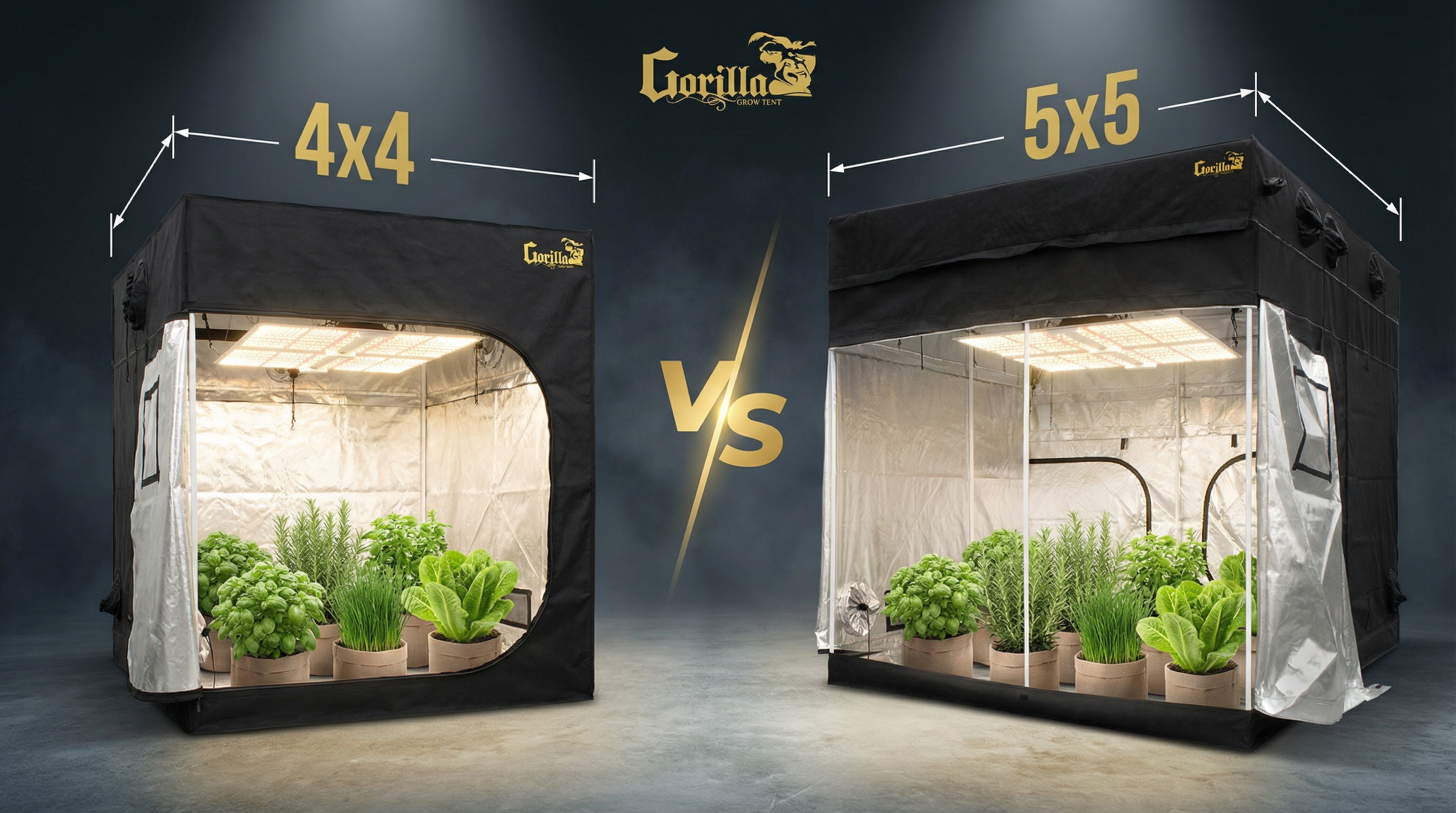
Keep learning: Indoor Herb Garden Setup Guide · VPD Chart for Grow Tents · 4x4 vs 5x5 Grow Tent Comparison
Stop Restarting Seeds Every Spring
A proper seed-starting tent and LED eliminate legginess permanently — and produce short, stocky seedlings that transplant with near-zero losses.