How to Choose the Perfect Dehumidifier for Your Grow Tent in 2026
Introduction
Excess humidity is the silent killer of indoor gardens. If you've ever lost plants to bud rot, powdery mildew, or mold, you understand the frustration—and the financial loss. A properly sized dehumidifier for your grow tent isn't optional; it's essential equipment for serious cultivators.
Here's a fact that surprises many growers: according to indoor agriculture research from Controlled Environment Agriculture Center (CEAC), maintaining humidity between 40-60% during flowering can increase yield quality by up to 30% while virtually eliminating mold-related crop losses.
As someone who has tested dozens of dehumidification solutions across various tent sizes over the past eight years, I've learned that choosing the right unit involves more than grabbing whatever's on sale. Tent size, plant count, growth stage, and local climate all factor into your decision.
This guide gives you everything you need: sizing formulas, setup strategies, and proven techniques to maintain optimal humidity year-round. By the end, you'll know exactly what dehumidifier your grow tent requires and how to integrate it properly.
The Science Behind Humidity and Plant Health
Plants naturally release moisture through transpiration. A single mature plant can transpire 95-99% of the water it absorbs, releasing it directly into your tent's enclosed environment. In a 4x4 grow tent with four plants, this translates to roughly 1-2 gallons of water vapor daily entering your growing space.
Without proper dehumidification, this moisture accumulates rapidly. Relative humidity (RH) can spike above 80% within hours, creating ideal conditions for Botrytis cinerea (gray mold) and powdery mildew spores to flourish.

Different growth phases demand different humidity levels. Here's the 2026 standard recommendation based on Vapor Pressure Deficit (VPD) research:
- Seedling/Clone: 65-75%
- Vegetative: 50-70%
- Early Flower: 45-55%
- Late Flower: 40-50%
- Drying/Curing: 55-62%
Understanding these ranges is foundational. For comprehensive strategies on managing moisture at each stage, our guide on how to decrease humidity in grow tent provides additional actionable techniques.
Signs Your Tent Has Humidity Problems
Watch for these warning indicators:
- Water droplets forming on tent walls or plant leaves
- Musty or stale smell when opening the tent
- White fuzzy growth on soil surface or lower stems
- Leaf edges curling downward (overhydration stress)
- Slow flower development during bloom phase
When I first started growing, I ignored condensation on my tent's mylar lining. Within two weeks, I lost 40% of my harvest to bud rot. That expensive lesson taught me that prevention through dehumidification costs far less than crop replacement.
How to Size a Dehumidifier for Your Grow Tent
The Pint-Per-Day Formula
Dehumidifiers are rated by moisture removal capacity, measured in pints per 24 hours. This step-by-step sizing framework ensures you select adequate capacity:
- Calculate your tent's cubic footage: Length × Width × Height = Cubic Feet
-
Factor your plant count and size:
- Small plants (under 2 feet): 0.5 pints/day each
- Medium plants (2-4 feet): 1 pint/day each
- Large plants (4+ feet): 1.5-2 pints/day each
-
Add climate adjustment:
- Humid climates (70%+ ambient RH): Add 30% capacity
- Moderate climates: Standard calculation
- Dry climates (under 40% ambient): Reduce 20%
-
Account for grow medium:
- Hydroponic systems: Add 20% capacity
- Coco coir: Add 10% capacity
- Soil: Standard calculation
Dehumidifier Sizing Chart by Tent Size
Use this quick-reference chart for common Gorilla Grow Tent dimensions:
| Tent Size | Cubic Feet | Plant Capacity | Recommended Dehumidifier |
|---|---|---|---|
| 2x2.5 | 35 cu ft | 1-2 plants | 20-30 pint/day |
| 3x3 | 63 cu ft | 2-4 plants | 30-40 pint/day |
| 4x4 | 112 cu ft | 4-6 plants | 40-50 pint/day |
| 5x5 | 175 cu ft | 6-9 plants | 50-70 pint/day |
| 4x8 | 224 cu ft | 8-12 plants | 70-90 pint/day |
| 8x8 | 448 cu ft | 12-16 plants | 90-120 pint/day |
| 10x10 | 700 cu ft | 16-25 plants | 120+ pint/day |
Note: These recommendations assume flowering stage requirements with moderate ambient humidity. Adjust upward for humid climates or dense canopies.

Portable vs. Ducted Dehumidifier Systems
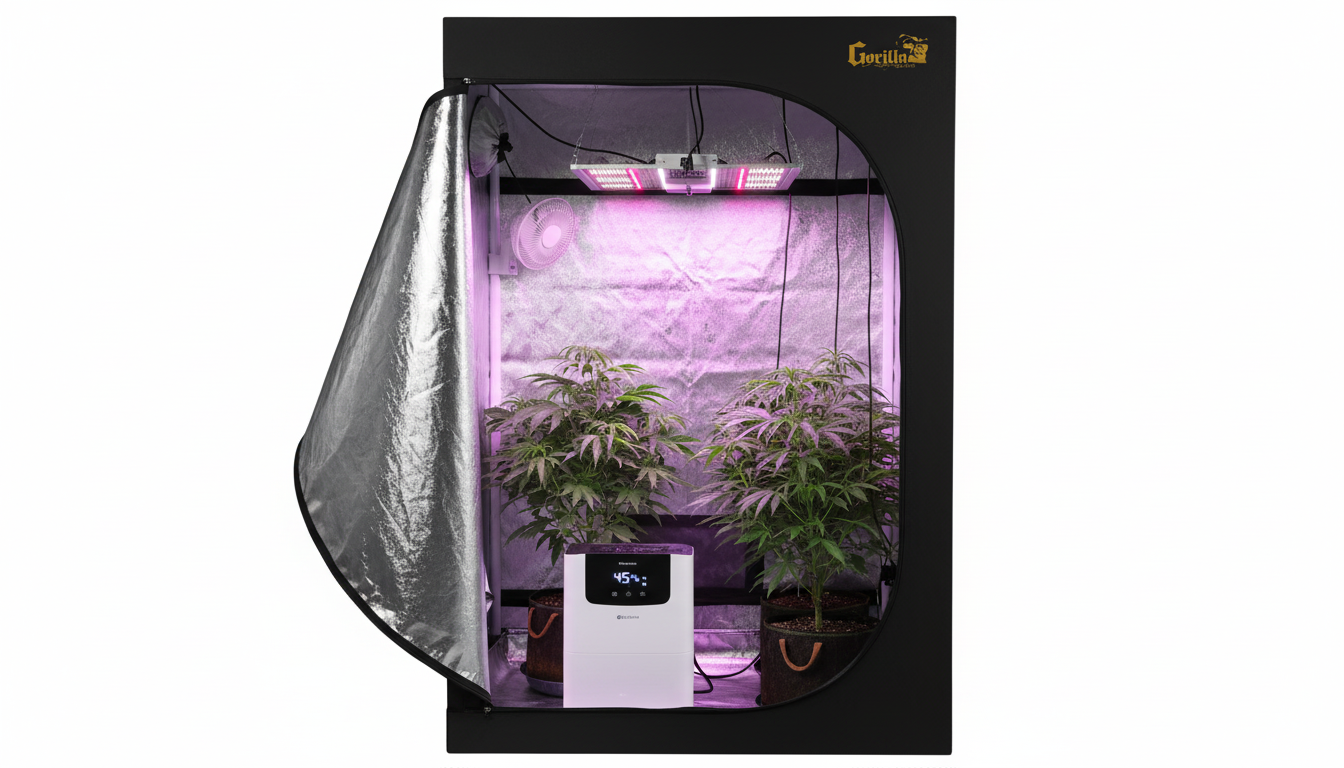
For most home cultivators using tents up to 5x5, portable dehumidifiers offer the best balance of effectiveness and value. Position them inside the tent or immediately outside with ducting.
Commercial-grade ducted systems become necessary for larger operations or multi-tent setups. These units mount externally and distribute dry air through your existing ventilation infrastructure.
Proper air circulation amplifies dehumidifier effectiveness significantly. Our Inline Duct Fan collection provides the airflow necessary to distribute dehumidified air evenly throughout your canopy, preventing humidity pockets.
Setting Up Your Dehumidifier for Maximum Effectiveness
Optimal Placement Inside Your Tent
Where you place your dehumidifier matters as much as its capacity. Follow these placement principles:
Best positions:
- Below canopy level (humidity settles downward)
- Near the tent's intake vent
- Away from direct light exposure
- On a raised platform for drainage access
Avoid placing:
- Directly under dripping irrigation lines
- Touching tent walls (restricts airflow)
- Behind dense foliage (limits air intake)
Integrating with Your Environmental Control System
Modern grow tent climate management requires coordinated equipment. Your dehumidifier should work alongside—not against—your other systems.
The Integration Hierarchy:
- Monitoring First: Install a Temperature and Humidity Sensor to establish baseline readings and track improvements after dehumidifier installation.
- Ventilation Coordination: Set your exhaust fan to activate at humidity thresholds (typically 5% above target) while your dehumidifier handles continuous moisture management.
- Timing Optimization: Program dehumidifiers to run at higher intensity during lights-off periods when humidity spikes naturally due to decreased transpiration and temperature drops.
For detailed environment management strategies, our comprehensive guide on maintaining optimal conditions in growing tents covers the complete integration process.
Drainage Solutions That Prevent Problems
Most dehumidifiers offer three drainage options:
| Method | Best For | Maintenance Level |
|---|---|---|
| Internal reservoir | Small units, light duty | High (daily emptying) |
| Gravity drain hose | Ground-level placement | Low |
| Condensate pump | Elevated placement | Medium |
My recommendation: always use continuous drainage when possible. A full reservoir triggers auto-shutoff, leaving your tent unprotected until you manually empty it. I've seen humidity spike from 45% to 78% overnight from a full reservoir shutdown.
Advanced Humidity Control Strategies for 2026
VPD-Based Dehumidification
Vapor Pressure Deficit (VPD) represents the difference between moisture in the air and moisture the air can hold. Progressive cultivators in 2026 target VPD ranges rather than arbitrary humidity percentages.
Optimal VPD Targets:
- Vegetative: 0.8-1.2 kPa
- Flowering: 1.2-1.6 kPa
VPD-based control requires considering both temperature and humidity simultaneously. When your temperature rises, your dehumidifier needs to work harder to maintain optimal VPD, even if the relative humidity reading appears acceptable.
Combining Dehumidification Methods
A dehumidifier alone may not suffice during critical flowering periods or in challenging climates. Layer these complementary approaches:
- Strategic defoliation: Removing lower fan leaves reduces transpiration surface area by 15-25%
- Raised container platforms: Elevates plants above any standing moisture
- Oscillating fans: Prevents humid air pockets around dense flower sites
- Light schedule optimization: Extending dark period gradually reduces nighttime humidity spikes
Our guide on how to bring humidity down in grow tent explores these methods in greater depth.
The Drying Phase: When Precision Matters Most
After harvest, humidity control becomes even more critical. Improper drying conditions cause 40% of post-harvest quality loss, according to post-harvest handling research.
For the drying phase, consider a dedicated Drying Tent separate from your main growing space. This isolation allows precise humidity control (targeting 55-62% RH) without compromising conditions for plants still in production.
Frequently Asked Questions About Grow Tent Dehumidifiers
Q1: What size dehumidifier do I need for a 4x4 grow tent?
A 4x4 grow tent typically requires a 40-50 pint per day dehumidifier during flowering stage. This accounts for 4-6 mature plants transpiring heavily. In humid climates or with dense canopies, increase to 50-60 pints for adequate moisture control.
Q2: Can I place my dehumidifier outside the grow tent?
Yes, placing a dehumidifier outside works if you duct conditioned air into the tent. This method reduces heat load inside your growing space since dehumidifiers generate significant warmth during operation. Ensure ducting is properly sealed to prevent efficiency loss.
Q3: How much does running a grow tent dehumidifier cost in electricity?
A 50-pint dehumidifier typically consumes 500-700 watts, costing approximately $1.50-3.00 daily at average 2026 electricity rates. Energy-efficient models with inverter compressors reduce operating costs by 30-40% while maintaining effectiveness.
Q4: Should my dehumidifier run 24/7 in the grow tent?
Continuous operation isn't always necessary. Most growers run dehumidifiers more intensively during dark periods when humidity naturally spikes. Use a humidistat controller to automate operation, activating the unit only when humidity exceeds your target threshold.
Q5: Why is my grow tent still humid even with a dehumidifier running?
Common causes include undersized units, poor airflow preventing humid air from reaching the dehumidifier, overwatering practices, or inadequate ventilation. Verify your dehumidifier's capacity matches your tent size and plant count using the sizing formula in this guide.
Q6: What's the difference between a grow tent dehumidifier and a regular home dehumidifier?
Functionally, they're similar. However, units marketed for cultivation often feature more durable construction, better low-temperature performance, and precise humidity controls. Standard home dehumidifiers work effectively in grow tents if properly sized.
Q7: When during the grow cycle do I need dehumidification most?
The flowering stage demands the most aggressive dehumidification. Target 40-50% RH during late flower to prevent bud rot and mold. Vegetative plants tolerate higher humidity, making dehumidification less critical—though still beneficial—during this phase.
Conclusion: Take Control of Your Grow Tent Humidity Today
Choosing the right dehumidifier for your grow tent protects your investment and dramatically improves harvest quality. Remember these essential points:
- Size matters: Use the pint-per-day formula based on tent volume, plant count, and climate factors
- Placement optimizes performance: Position below canopy level with unobstructed airflow
- Integration amplifies results: Coordinate with sensors, fans, and environmental controls
- Growth stage determines targets: Adjust humidity goals from seedling through harvest
- Prevention beats treatment: Proper dehumidification eliminates mold before it starts
Don't wait until you spot the first signs of bud rot or powdery mildew. Every day without proper humidity control is a risk to your harvest.
Ready to Perfect Your Growing Environment?
Shop Gorilla Grow Tent Climate Control Solutions →
Start with accurate monitoring using our professional-grade temperature and humidity sensors, then build your complete environmental control system. Your plants—and your harvest—will thank you.
Questions about humidity control for your specific setup? Contact our growing experts for personalized recommendations.