Where Do Indoor Plants Grow Naturally? A Houseplant Origin Guide
Most popular indoor plants grow naturally in tropical and subtropical rainforests — specifically the understory of Central and South America, Southeast Asia, West and East Africa, and parts of the Pacific. The light levels, humidity, and temperature that make your living room comfortable are almost never the ones your plants actually evolved for.
That is why monstera leaves yellow in dry winter air, why fiddle leaf figs drop leaves when moved, and why your orchid refuses to rebloom. If you can replicate your plant's native habitat — stable 65–80°F temperatures, 50–70% humidity, consistent bright-but-filtered light, and the right airflow — it will grow the way it does in the wild.
The plants you keep on your shelf, windowsill, or desk are not "houseplants" in nature — they are rainforest climbers, rock-crevice succulents, and forest-floor understory species that humans discovered centuries ago and domesticated. Monstera climbs 60-foot ficus trees in the Costa Rican cloud forest. Pothos hangs from tree canopies in the Solomon Islands. The snake plant on your bookshelf evolved in the bone-dry lowlands of West Africa.
This guide maps where each of the 12 most popular indoor plants grows naturally, what their native climate is, and how to replicate it inside your home — with a grow tent, full-spectrum LED, humidity sensor, or just smarter placement. Understanding origin is the shortcut to plants that thrive instead of just survive.
On This Page
Why Knowing a Plant's Origin Matters
Every plant's ideal care conditions are a fingerprint of the climate it evolved in. A monstera from the Guatemalan rainforest wants diffused overhead light, warm humid air, and a moss-pole climbing surface — not a desk in front of a west-facing window with a dry heater vent nearby. A snake plant from coastal West Africa wants bright indirect light, bone-dry soil, and low humidity — the opposite environment.
When plants refuse to thrive, origin mismatch is almost always the cause. Pale leaves, leaf drop, stretched growth, or failure to flower are not random — they are the plant telling you its current conditions do not match the ones it evolved for. Matching origin-based conditions indoors is the single biggest lever for healthy houseplants.
World Map of Houseplant Origins: Six Key Regions
Almost every popular indoor plant traces back to one of six biogeographic zones.
🌴 Central & South America
Monstera, philodendron, peace lily, bromeliads, anthurium, calathea, peperomia
🌏 Southeast Asia & Pacific
Pothos, orchid (epiphytes), fiddle leaf fig cousins, alocasia, rubber plant (ficus)
🌍 West & Central Africa
Fiddle leaf fig, peace lily, African violet, sansevieria (snake plant), ZZ plant
🌵 Global Arid / Desert Regions
Succulents (Americas, Africa), cacti (Americas), aloe (Africa/Arabia), jade plant, haworthia
🏞️ East Africa & Madagascar
ZZ plant, dracaena, bird of paradise (Strelitzia), kalanchoe, spider plant cousins
🍋 Mediterranean & Subtropical
Citrus (lemon, orange, lime), rosemary, bay laurel, olive, myrtle
12 Popular Houseplants & Their Native Habitats
Monstera Deliciosa
Swiss Cheese Plant- Native Region
- Southern Mexico to Panama — tropical rainforest understory
- Natural Habitat
- Climbs tree trunks toward the canopy; aerial roots grip bark
- Native Climate
- 75–85°F, 70–90% humidity, diffused filtered light
- Indoor Fix
- Bright indirect light, moss pole for climbing, 60%+ humidity
Pothos
Epipremnum aureum- Native Region
- Mo'orea, French Polynesia (Society Islands)
- Natural Habitat
- Climbs rainforest trees, drapes from canopies
- Native Climate
- 75–85°F year-round, 60–80% humidity
- Indoor Fix
- Most forgiving houseplant — tolerates lower humidity, medium-low light
Snake Plant
Dracaena trifasciata- Native Region
- West Africa — Nigeria to the Democratic Republic of the Congo
- Natural Habitat
- Dry rocky lowlands and savanna edges
- Native Climate
- 70–90°F, 30–50% humidity, tolerates bright sun to low shade
- Indoor Fix
- Let soil dry fully; will not mind dry winter air; low-maintenance
Fiddle Leaf Fig
Ficus lyrata- Native Region
- Western Africa — Cameroon to Sierra Leone, lowland rainforest
- Natural Habitat
- Starts as epiphyte on other trees, then strangler fig
- Native Climate
- 75–85°F, 65–80% humidity, stable conditions year-round
- Indoor Fix
- Hates location changes, drafts, and dry air — humidifier recommended
Philodendron
Philodendron spp.- Native Region
- Tropical Americas — Brazil, Colombia, Central America
- Natural Habitat
- Rainforest understory; climbs or trails
- Native Climate
- 70–85°F, 60–80% humidity, diffused canopy light
- Indoor Fix
- Very adaptable; prefers bright indirect light and consistent moisture
Spider Plant
Chlorophytum comosum- Native Region
- South and southern Africa — Cape region to Mozambique
- Natural Habitat
- Forest edges and partially shaded grasslands
- Native Climate
- 60–80°F, 40–60% humidity, bright filtered light
- Indoor Fix
- Thrives on neglect; pair with the right grow light for spider plants
ZZ Plant
Zamioculcas zamiifolia- Native Region
- East Africa — Kenya, Tanzania, Mozambique, South Africa
- Natural Habitat
- Dry rocky grasslands and forest edges with seasonal rainfall
- Native Climate
- 70–85°F, 30–50% humidity, survives drought via rhizomes
- Indoor Fix
- Water every 2–3 weeks; tolerates very low light; nearly indestructible
Peace Lily
Spathiphyllum wallisii- Native Region
- Colombia and Venezuela — Amazonian rainforest floor
- Natural Habitat
- Dim understory along streams and damp soil
- Native Climate
- 70–85°F, 70%+ humidity, very low direct light
- Indoor Fix
- Perfect for dim rooms; droops dramatically when thirsty — a built-in signal
Rubber Plant
Ficus elastica- Native Region
- Northeast India, Nepal, Bhutan, Myanmar, Malaysia
- Natural Habitat
- Lowland rainforest; mature trees reach 100+ feet
- Native Climate
- 75–85°F, 50–80% humidity, bright indirect light
- Indoor Fix
- Very hardy; tolerates lower humidity than fiddle leaf fig
Alocasia
Alocasia spp. (Elephant Ear)- Native Region
- Southeast Asia — Philippines, Borneo, Indonesia, India
- Natural Habitat
- Rainforest understory with constant moisture
- Native Climate
- 75–85°F, 70%+ humidity, diffused bright light
- Indoor Fix
- Dramatic leaves require tropical conditions; see our alocasia lighting guide
Orchid (Phalaenopsis)
Phalaenopsis spp.- Native Region
- Southeast Asia — Philippines, Taiwan, Borneo, Indonesia, Australia
- Natural Habitat
- Epiphyte clinging to tree branches in humid forests
- Native Climate
- 70–85°F day / 55–65°F night, 60–80% humidity, filtered canopy light
- Indoor Fix
- Needs a night temperature drop to trigger rebloom; loves bark medium over soil
Citrus (Lemon, Orange, Lime)
Citrus spp.- Native Region
- Southeast Asia — India, China, Malaysia (subtropical)
- Natural Habitat
- Warm subtropical hillsides with full sun and well-drained soil
- Native Climate
- 60–85°F, 40–60% humidity, direct sun (800+ µmol/m²/s)
- Indoor Fix
- Demands high-output LED; see our citrus grow light guide
Replicating Native Habitat Indoors
Once you know a plant's origin, replicating its conditions is mostly about three variables: light, temperature, and humidity. The fourth — airflow — is the most overlooked.
Light: Matching Canopy Filtering
Tropical understory plants (monstera, peace lily, pothos, philodendron) evolved under 200–600 µmol/m²/s PPFD — what reaches the forest floor after leaves filter overhead sun. In your home:
- Bright indirect window: approximately 100–400 µmol/m²/s when within 3 feet of a north or east-facing window
- Supplemental LED: a Gorilla Xi220 full-spectrum LED at 30–50% dim delivers 200–400 µmol/m²/s — the exact rainforest understory range
- See our LED distance chart for exact hang heights
Temperature: Stable, Not Extreme
Tropical plants do not want hot — they want stable. A windowsill with morning sun hitting 90°F, then an afternoon cold draft from an AC vent, is far worse than a consistent 72°F all day. Use a WiFi temperature sensor to catch swings you cannot feel.
Humidity: The Silent Killer
Most North American homes run 20–30% relative humidity in winter with central heat. Tropical plants evolved for 60–80%. The gap causes leaf crisping, slow growth, and pest outbreaks.
| Humidity Range | Thriving Plants | Struggling Plants |
|---|---|---|
| 20–35% (dry home) | Snake plant, ZZ plant, most succulents, cacti | Monstera (brown tips), fiddle leaf fig (leaf drop), orchids (will not bloom) |
| 35–50% (normal home) | Pothos, philodendron, spider plant, citrus | Alocasia (slow growth), ferns (crispy fronds) |
| 50–70% (grow tent or bathroom) | Monstera, fiddle leaf fig, alocasia, orchid, ferns | Dry-climate succulents may rot |
| 70%+ (terrarium or humid tent) | Carnivorous plants, jewel orchids, calathea | Most common houseplants |
Airflow: What Open Pots & Windowsills Miss
In the wild, tropical canopies always have gentle air movement — trade winds, convection from forest-floor evaporation. Inside a closed room, stagnant air causes fungal disease, pest buildups, and weak stems. A small clip fan on low or a smart inline duct fan inside a grow tent solves this entirely.
Quick Reference: Origin → Care Matrix
| Plant | Origin | Temp | Humidity | PPFD |
|---|---|---|---|---|
| Monstera | Central America rainforest | 75–85°F | 60–80% | 200–500 |
| Pothos | French Polynesia | 75–85°F | 50–70% | 150–400 |
| Snake plant | West Africa savanna | 70–90°F | 30–50% | 100–400 |
| Fiddle leaf fig | West African rainforest | 75–85°F | 60–80% | 300–600 |
| Philodendron | South American rainforest | 70–85°F | 60–80% | 200–500 |
| Spider plant | Southern Africa | 60–80°F | 40–60% | 150–400 |
| ZZ plant | East Africa dry forest | 70–85°F | 30–50% | 50–300 |
| Peace lily | Colombia rainforest floor | 70–85°F | 60–80% | 100–300 |
| Rubber plant | Northeast India / Malaysia | 75–85°F | 50–70% | 300–500 |
| Alocasia | Southeast Asian rainforest | 75–85°F | 70%+ | 300–500 |
| Orchid | Southeast Asian forests | 70–85°F (night 55–65°F) | 60–80% | 200–400 |
| Citrus | Subtropical Asia | 60–85°F | 40–60% | 600–1,000 |
Common Origin-Based Mistakes
| Mistake | Why It Fails | Fix |
|---|---|---|
| Treating a monstera like a desert plant | Low humidity causes brown leaf edges and slow growth | Raise humidity to 60%+ with a humidifier or grow tent |
| Giving a snake plant rainforest conditions | Too-wet soil causes root rot; high humidity invites pests | Dry soil completely between waterings; accept low RH |
| Placing a fiddle leaf fig in variable light | FLFs hate change — leaves drop when moved or drafted | Pick one bright spot, keep it there, avoid heater vents |
| Keeping orchids at steady temperature year-round | Orchids need a 10°F night drop to trigger rebloom | Let nighttime temps drop to 55–65°F for 2 weeks in fall |
| Growing citrus without a real grow light | Citrus demands 600+ µmol/m²/s — windowsills rarely deliver | Supplement with a full-spectrum LED at 12–18" above canopy |
| Misting tropical plants to "boost humidity" | Misting evaporates in minutes; brief peak, no lasting effect | Use a cool-mist humidifier or keep plants inside a grow tent |
| Using cold tap water on tropical plants | Native rainfall is ambient temperature; cold shocks roots | Use room-temperature water or filtered water at 65–72°F |
If your plant grows naturally in a tropical forest, assume it wants warm + humid + filtered light + airflow. If it grows in a desert or savanna, assume the opposite — warm + dry + direct sun + minimal disturbance. Match those four variables and 80% of problems disappear.
Recommended Indoor Setup for Tropical Houseplants
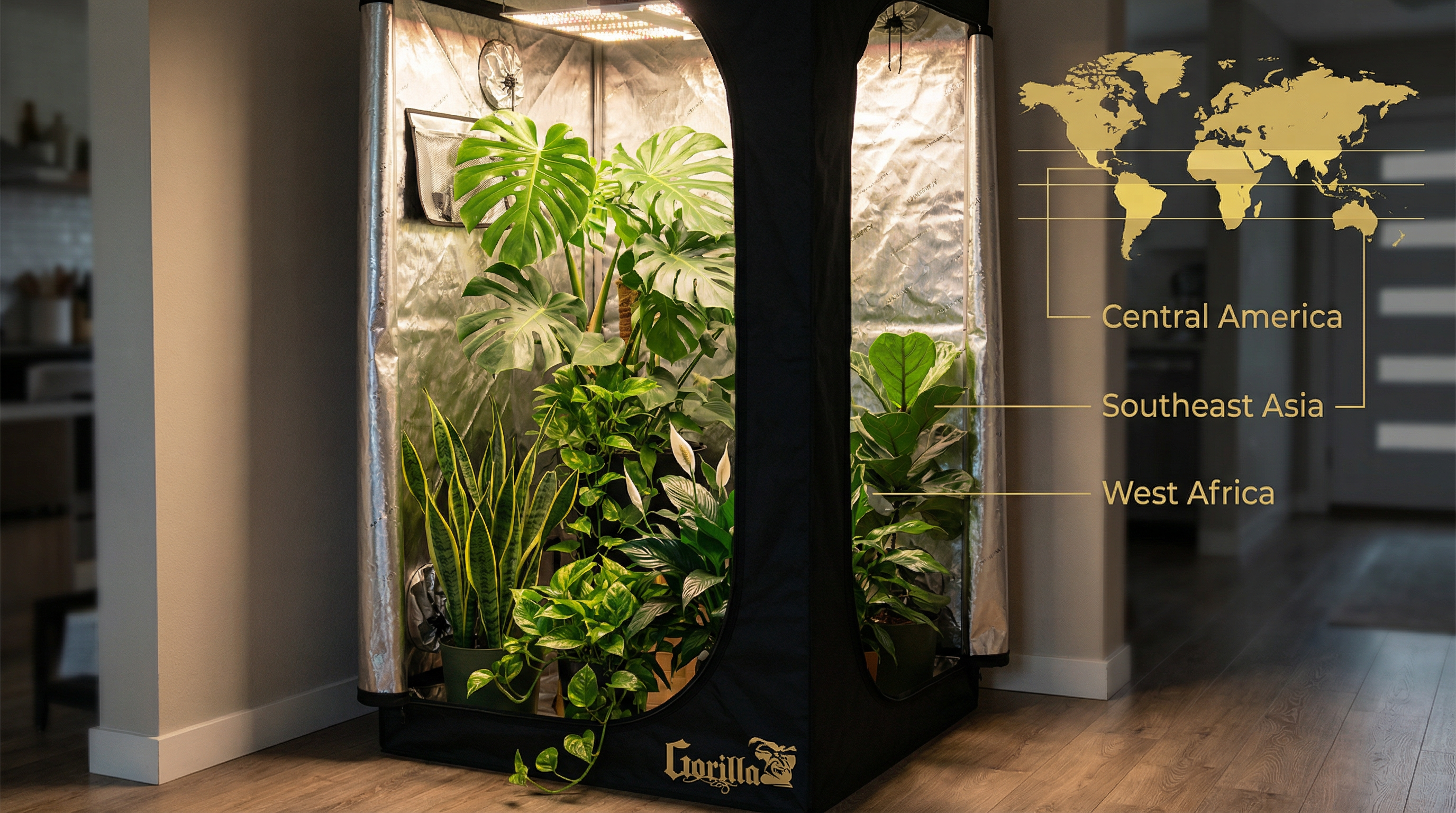
The fastest way to give tropical plants their native climate is a small grow tent with environmental control. A 2x2.5 tent fits 6–10 medium houseplants and costs less than a single fiddle leaf fig replacement over three years.
Frequently Asked Questions
Where do monstera plants come from naturally?
Monstera deliciosa is native to the tropical rainforests of southern Mexico through Panama. In the wild it climbs tree trunks toward the canopy, anchoring itself with aerial roots and developing its characteristic split leaves as it matures. Its native climate is 75–85°F with 70–90% humidity under filtered canopy light.
Where are pothos plants originally from?
Pothos (Epipremnum aureum) originated on Mo'orea in French Polynesia, not in the rainforests of Southeast Asia as is commonly believed. It naturally climbs tree trunks and drapes from canopies in warm tropical forests with 60–80% humidity.
What is the native habitat of snake plants?
Snake plants (Dracaena trifasciata, formerly Sansevieria) grow naturally in the dry rocky lowlands and savanna edges of West Africa, from Nigeria to the Democratic Republic of the Congo. Their thick leaves evolved to store water through long dry seasons.
Where do fiddle leaf figs grow naturally?
Fiddle leaf figs (Ficus lyrata) are native to the lowland rainforests of western Africa — from Cameroon to Sierra Leone. In the wild they start as epiphytes on other trees before becoming strangler figs. They want stable 75–85°F temperatures and 65–80% humidity year-round.
Do orchids grow naturally in the wild?
Yes — most common houseplant orchids (Phalaenopsis) originate in the tropical forests of Southeast Asia, including the Philippines, Taiwan, Borneo, and Indonesia. They are epiphytes, clinging to tree branches with exposed roots rather than rooting in soil.
Why does knowing a plant's origin matter for houseplant care?
Origin determines what temperature, humidity, light level, and airflow a plant evolved for — and those are the four biggest levers in houseplant care. Mismatching conditions causes nearly every common problem: yellow leaves, leaf drop, stretched growth, failure to flower.
Can houseplants from different regions live together?
Only if their native climates are similar. Tropical rainforest plants share a grow tent happily. Desert succulents and tropical plants should never share a space — opposite humidity and watering needs.
What temperature do tropical houseplants need?
Most tropical houseplants want a stable 70–85°F during the day with a slight 5–10°F drop at night. Stable is more important than warm.
How much humidity do houseplants from tropical regions need?
Monstera, fiddle leaf figs, alocasia, orchids, and ferns want 60–80% humidity. Pothos, philodendron, and spider plants tolerate 40–60%. Snake plants, ZZ plants, and succulents prefer 30–50%.
Are there houseplants that grow naturally in cold regions?
Few popular indoor plants originate in cold regions. Most easy houseplants trace back to tropical or subtropical zones — which is why they suffer in cold drafty apartments.
Related Guides
Dive deeper by plant: Grow Light for Spider Plants · Grow Lights for Alocasia · Grow Light for Citrus Trees · Using Grow Lights for Tomatoes
Setup guides: Grow Light Distance Chart · VPD Chart · Indoor Herb Garden
Give Your Plants Their Native Climate
A small grow tent with humidity, temperature, and light control replicates rainforest-understory conditions in any spare corner of your home.