Best Rated LED Grow Lights 2025: The Ultimate Buyer's Guide and Reviews
Choosing the right LED grow light can feel overwhelming when hundreds of options flood the market, each claiming to be "the best." Some deliver on their promises with exceptional performance and years of reliable service. Others disappoint with poor coverage, premature failure, or underwhelming results despite impressive marketing claims.
The difference between mediocre and outstanding LED grow lights often determines whether you achieve dense, high-quality harvests or struggle with lackluster results that barely justify the electricity costs. After testing countless systems and analyzing thousands of real-world grower experiences, clear winners have emerged across different price points and growing applications.
This comprehensive guide cuts through the marketing hype to reveal the best rated LED grow lights of 2025—systems that consistently deliver superior performance, exceptional build quality, and genuine value that justifies their investment.
What Makes a LED Grow Light Truly "Best Rated"?
Before diving into specific models, understanding evaluation criteria ensures you choose lights based on performance rather than marketing promises.
Actual Performance vs. Advertised Specifications
The LED industry suffers from rampant specification inflation. Many manufacturers advertise "1000W equivalent" lights that actually draw 100W from the wall, or claim coverage areas impossible to achieve at adequate intensity levels.
Best rated lights provide honest specifications backed by independent testing. They specify actual wall draw (not equivalent wattage), provide PAR maps showing actual light distribution, and give realistic coverage areas based on minimum PPFD requirements rather than marketing fantasies.
PPFD (Photosynthetic Photon Flux Density) represents the most critical metric—it measures how many photons actually reach your plants per second. Quality lights provide detailed PPFD maps showing intensity across their entire coverage area, allowing informed comparisons.
For reference, plants need these minimum PPFD levels:
- Low-light plants: 100-300 μmol/s/m²
- Medium-light plants: 300-600 μmol/s/m²
- High-light vegetables and herbs: 600-900 μmol/s/m²
- Flowering and fruiting plants: 800-1200+ μmol/s/m²
Top-rated systems achieve these levels consistently across their specified coverage areas without dramatic falloff at edges.
Build Quality and Component Selection
The best LED grow lights use premium components that ensure longevity and consistent performance:
LED chips matter enormously. Samsung LM301H and LM301B diodes represent the gold standard, offering exceptional efficiency and reliability. Osram Oslon SSL diodes provide the best red spectrum performance. Generic or no-name LEDs typically fail prematurely and deliver inferior spectrum quality.
Driver quality determines lifespan. Mean Well drivers—the industry standard—last 50,000+ hours with minimal degradation. Cheap generic drivers often fail within 10,000-20,000 hours, requiring expensive replacements.
Heatsink design affects everything. Quality passive heatsinks (no fans) dissipate heat silently while extending LED lifespan. Aluminum construction with adequate surface area keeps diodes cool, preventing premature failure and maintaining output over time.
Construction materials reflect commitment to quality. Industrial-grade aluminum frames, IP65-rated waterproofing, and reinforced mounting points separate professional equipment from consumer-grade products.
Energy Efficiency: The Long-Term Cost Factor
Efficiency ratings (measured in μmol/J or micromoles per joule) determine how effectively lights convert electricity into usable photons:
Budget lights deliver 1.5-2.0 μmol/J—acceptable but not impressive Quality mid-range lights achieve 2.3-2.7 μmol/J—excellent efficiency Premium professional systems reach 2.7-3.1+ μmol/J—industry-leading performance
Higher efficiency means lower electricity bills and less heat generation. Over a light's 5-10 year lifespan, efficiency differences translate to hundreds of dollars in energy savings.
Real-World Grower Feedback
Marketing claims mean nothing compared to verified grower results. Best rated lights accumulate thousands of genuine reviews from users achieving consistent success across diverse growing scenarios.
Look for patterns in feedback: Do growers consistently report strong yields? Do lights maintain performance over multiple growing cycles? Does customer service stand behind their products when issues arise?
The GXi Series LED Grow Lights exemplify this approach with technology developed through hundreds of thousands of hours of field testing by professional Northern California cultivators—not just lab conditions but real-world growing scenarios.

Best Rated LED Grow Lights by Growing Space
Different tent sizes demand appropriately scaled lighting for optimal results and efficiency.
Best for 2x2 Grow Spaces (Small Tents)
Coverage requirement: 4 square feet needing 200-300W of quality LED power
The Xi220 LED Grow Light dominates this category with 220W of targeted full-spectrum output perfectly matched to 2x2-2.5x2.5 footprints. Its tri-channel spectrum control (targeted full spectrum, BudBooster IR, and TrichomeForce UV) provides unprecedented control typically reserved for commercial systems.
Key advantages:
- Actual 220W wall draw with 2.9+ μmol/J efficiency
- 800-1200 μmol/s/m² PPFD across coverage area
- External driver mounting reduces tent heat
- Wireless GXi control via smartphone app
- Sunrise/sunset technology prevents light shock
- Premium Samsung/Osram diodes rated 50,000+ hours
Ideal for: 2-4 plants in compact spaces, hobbyist growers wanting professional results, propagation and mother plant maintenance
Alternative budget option: Spider Farmer SF-1000 provides solid 100W performance at lower cost but lacks advanced spectrum control and smart features.
Best for 3x3 Grow Spaces (Medium Tents)
Coverage requirement: 9 square feet needing 300-400W of quality LED power
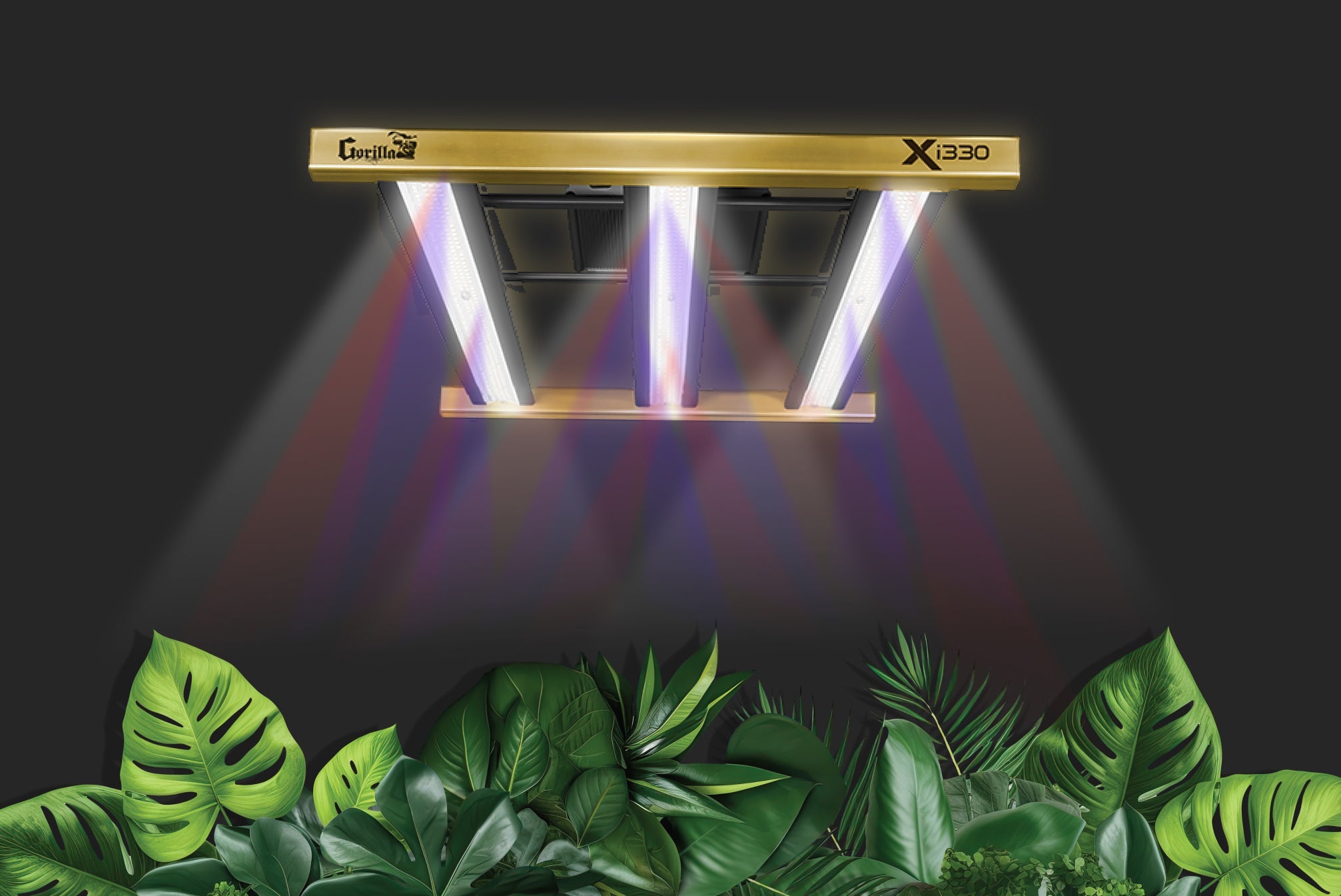
The Xi330 LED Grow Light strikes the perfect balance between performance and value for medium spaces. With 330W of power and the same advanced spectrum control as its larger siblings, it delivers professional-grade results in the most popular hobbyist tent size.
Key advantages:
- 330W actual draw with industry-leading efficiency
- Covers 3x3 flowering, 4x4 vegetative growth
- Complete tri-channel spectrum programmability
- Integrated with GXi ecosystem for automated control
- Passive cooling (fanless) for silent operation
- Premium build quality with 5-year warranty
Ideal for: 4-6 plants in 3x3 tents, serious hobbyists, year-round growing, diverse plant types
For those seeking budget alternatives, the Mars Hydro TSW-2000 (300W) offers decent performance at reduced cost, though it lacks the advanced features and efficiency of premium options.
Best for 4x4 Grow Spaces (Popular Standard)
Coverage requirement: 16 square feet needing 480-600W of quality LED power
The Xi420 LED Grow Light represents the sweet spot for serious home growers. At 420W, it provides the intensity needed for maximum yields in standard 4x4 tents without excessive energy consumption.
Key advantages:
- 420W optimized for 4x4 flowering coverage
- 1000-1200 μmol/s/m² across entire canopy
- Advanced IR/UV capabilities enhance terpene production
- Smart spectrum presets calibrated by master growers
- Heat management allowing optimal light positioning
- Daisy-chain capability for expanded setups
Ideal for: 6-9 plants in 4x4 spaces, maximum yield focus, diverse crop types, commercial-quality results
The Spider Farmer SF-4000 (450W) and HLG 550 V2 represent quality alternatives in this category, both delivering excellent performance with slightly different spectrum approaches and feature sets.
Best for 5x5 and Larger Spaces
Coverage requirement: 25+ square feet needing 750-1000W of quality LED power
The Xi750 LED Grow Light commands large spaces with 750W of precisely targeted spectrum. This powerhouse supports commercial-scale production in home environments, delivering 2+ pounds per harvest potential when conditions optimize.
Key advantages:
- 750W covering 4x4-5x5 flowering spaces
- Professional-grade PPFD maintaining 800-1200+ μmol/s/m²
- Complete environmental integration via GXi ecosystem
- Adaptive climate control responding to heat load
- Built to Gorilla's legendary durability standards
- RedLine performance mode maximizes genetic potential
Ideal for: Large home operations, commercial growing, maximum production focus, advanced growers
For even larger commercial applications, multiple Xi750 units can be integrated through the GXi system for coordinated control across extensive growing areas.
Best Rated LED Grow Lights by Budget
Quality lights exist at various price points—knowing what to expect at each level ensures realistic expectations.
Budget Champions (Under $150)
What to expect: Basic full-spectrum coverage adequate for 2x2-2.5x2.5 spaces, simple controls, decent but not premium components
Top pick: Spider Farmer SF-1000 ($110-130)
- Actual 100W draw
- Samsung LM301B diodes
- Simple dimming function
- Suitable for beginners and budget builds
Limitations: No spectrum control, basic construction, shorter warranty periods, reduced efficiency compared to premium models
Best for: First-time growers testing indoor cultivation, supplemental lighting, propagation areas, strict budget constraints
These lights perform adequately but lack the features and longevity of mid-range and premium options. Expect to upgrade within 1-2 years as your growing ambitions expand.
Mid-Range Excellence ($200-400)
What to expect: Quality components, good efficiency (2.3-2.7 μmol/J), reliable performance, basic automation features
Top picks:
- Mars Hydro FC-E3000 ($280-320): 300W, excellent coverage uniformity, Samsung diodes
- Spider Farmer SF-2000 ($280-330): 200W bar-style design, good heat management
- Viparspectra XS Series ($250-350): Various wattages, decent efficiency, competitive pricing
Sweet spot characteristics: These lights deliver 80-90% of premium performance at 50-60% of the cost. They use quality Samsung diodes and Mean Well drivers but lack advanced spectrum control and smart features.
Best for: Serious hobbyists, proven grow success, budget-conscious growers wanting quality
Premium Professional ($400-800+)
What to expect: Top-tier components, maximum efficiency (2.7-3.1+ μmol/J), advanced features, comprehensive warranties
Top picks:
- Gorilla Xi Series ($450-750): Industry-leading spectrum control, wireless automation, Northern California-proven genetics
- HLG Blackbird ($600-800): Quantum board design, exceptional efficiency, proven commercial performance
- Mammoth Lighting 8-Bar ($700-900): Massive coverage, high-intensity output, commercial-grade construction
Premium advantages: These systems justify higher costs through superior performance, advanced features, extended lifespans, and exceptional customer support.
Best for: Commercial operations, advanced hobbyists, maximum yield focus, those wanting the absolute best
For a comprehensive comparison of professional options, explore this detailed guide to best LED grow lights across all categories.

Key Features That Separate Good from Great
Beyond basic specifications, certain features dramatically enhance growing success and user experience.
Spectrum Control and Customization
The ability to adjust light spectrum throughout growth cycles represents one of the most valuable advanced features:
Blue-heavy spectrums (vegetative growth) promote compact structure, strong stems, and lush foliage development. Plants grow bushier rather than stretching, creating ideal structure for heavy fruit production.
Red-enhanced spectrums (flowering/fruiting) trigger blooming responses, accelerate fruit development, and maximize harvest weight. Enhanced far-red wavelengths improve flowering speed.
UV supplementation (finishing stages) triggers defense responses that increase secondary metabolite production—enhancing potency, aroma, and flavor profiles.
The Xi Series' tri-channel control enables precise adjustment of these spectrum components throughout the entire growth cycle, allowing growers to dial in optimal conditions for specific plant varieties and growing goals.
Smart Automation and Control
Modern grows benefit tremendously from intelligent automation:
Smartphone connectivity allows remote monitoring and adjustment from anywhere. Check light status, modify schedules, and adjust intensity without physically accessing growing spaces.
Sunrise/sunset simulation gradually ramps intensity up and down, mimicking natural light transitions that reduce plant stress and improve overall health.
Coordinated environmental control integrates lighting with ventilation, temperature, and humidity management for holistic optimization. The GXi ecosystem exemplifies this approach.
Automated scheduling ensures consistent photoperiods without manual intervention. Set schedules once, then let automation handle daily operations.
Thermal Management
Effective heat dissipation determines both performance consistency and lifespan:
Passive cooling (no fans) operates silently while effectively managing heat through large aluminum heatsinks with extensive surface area.
External driver mounting relocates the primary heat source outside the growing area, reducing cooling requirements and maintaining optimal tent temperatures.
LED spacing affects heat concentration. Well-designed layouts spread diodes across larger areas, preventing hot spots that damage plants or degrade components.
Operating temperature directly impacts LED lifespan. Systems maintaining diodes below 85°C junction temperatures last significantly longer than those running hotter.
Build Quality and Durability
Premium lights justify their costs through construction that withstands years of demanding use:
Industrial-grade materials—thick aluminum frames, reinforced mounting points, and quality fasteners resist corrosion and mechanical stress.
Water resistance (IP65 rated components) protects sensitive electronics from humidity and occasional water exposure inevitable in growing environments.
Modular design allows component replacement if failures occur, extending usable life far beyond integrated designs requiring complete unit replacement.
Comprehensive warranties (3-5+ years) demonstrate manufacturer confidence in longevity and commitment to customer support.
Avoiding Common Mistakes When Buying LED Grow Lights
Even experienced growers sometimes make these critical errors:
Mistake #1: Focusing on "Wattage" Rather Than PPFD
"1000W equivalent!" means absolutely nothing. Two different "1000W" lights can deliver vastly different PPFD levels—one producing 800 μmol/s/m² (adequate) while another barely reaches 300 μmol/s/m² (insufficient).
Solution: Always check actual PPFD output across the coverage area. Reputable manufacturers provide detailed PAR maps showing intensity distribution. Avoid any light lacking this documentation.
Mistake #2: Buying Lights Too Small for Your Space
Underlit tents produce disappointing results regardless of other factors. Plants stretch, yields suffer, and quality declines.
Solution: Size lights properly from the start. Plan for 30-50W per square foot of growing area using quality LEDs. A 4x4 tent needs 480-800W depending on plant requirements—not 200-300W as some suggest.
For detailed guidance, consult this grow light distance and coverage chart that explains optimal positioning.
Mistake #3: Ignoring Efficiency Ratings
"It works!" doesn't mean it works well. A 600W light with 1.8 μmol/J efficiency costs significantly more to operate than a 400W light with 2.8 μmol/J efficiency producing identical PPFD.
Solution: Calculate long-term operating costs. Over 5 years, efficiency differences of 0.5+ μmol/J save hundreds in electricity while reducing cooling requirements.
Mistake #4: Choosing Based Solely on Price
The cheapest option rarely provides best value. Budget lights often fail prematurely, deliver poor yields, or cost more in electricity than modest upgrades to quality systems.
Solution: Consider total cost of ownership—purchase price plus electricity costs plus replacement expenses. Quality lights operating 50,000 hours outlast budget options requiring replacement after 10,000-20,000 hours.
Mistake #5: Neglecting Customer Support and Warranty
"Great price!" loses appeal when lights fail and companies disappear or refuse warranty claims.
Solution: Buy from established companies with proven customer service records. Gorilla Grow Tent's legendary support and comprehensive warranties exemplify this commitment to customer satisfaction.
Setting Up Your LED Grow Light for Maximum Performance
Even the best lights underperform with improper installation and positioning.
Optimal Hanging Height
Distance dramatically affects intensity following the inverse square law. Doubling distance quarters intensity—precision matters:
Seedlings: 24-36 inches (lower intensity prevents burning tender growth) Vegetative growth: 18-24 inches (moderate intensity promotes healthy development) Flowering/fruiting: 12-18 inches (maximum intensity drives production)
Always monitor plants for signs of light stress (bleaching, curling) indicating excessive intensity, or stretching indicating insufficient light. Adjust accordingly.
Proper Light Coverage
Even premium lights create intensity gradients from center to edges:
Center positioning ensures coverage extends across the entire growing area. Measure carefully before hanging.
Reflective walls (Mylar, white paint) recover 10-20% of light that would otherwise be lost, improving efficiency without additional electricity.
Plant rotation equalizes cumulative light exposure. Weekly rotation prevents edge plants from falling behind center specimens.
For complete environmental optimization, explore this comprehensive grow room setup guide covering all aspects of controlled cultivation.
Environmental Integration
Lights represent one component of holistic growing environments:
Temperature management prevents heat stress. Even efficient LEDs generate heat requiring adequate ventilation and air circulation.
Humidity control varies by growth stage. Seedlings prefer 60-70%, vegetative growth 50-60%, flowering 40-50% to prevent mold while maintaining healthy transpiration.
CO₂ supplementation (for advanced growers) enables plants to utilize PPFD levels exceeding 1000 μmol/s/m²—without supplementation, excess light stresses plants rather than improving growth.
Photoperiod consistency matters enormously. Use reliable timers ensuring precise light/dark cycles. Irregular schedules stress plants and can trigger unwanted responses like premature flowering.

FAQ: Best Rated LED Grow Lights
What's the best LED grow light brand in 2025?
No single "best" brand exists, but Gorilla (with GXi technology), HLG (Horticulture Lighting Group), Spider Farmer, and Mars Hydro consistently rank among top performers. Gorilla's Xi Series leads in advanced features and spectrum control, HLG excels in efficiency and reliability, Spider Farmer offers excellent value, and Mars Hydro provides budget-friendly options. Choose based on your specific needs, budget, and growing goals rather than brand alone.
How many watts of LED do I need per square foot?
Plan for 30-50W per square foot using quality, efficient LEDs (2.5+ μmol/J). A 4x4 grow tent (16 sq ft) needs 480-800W depending on plant types—leafy greens thrive with 30-35W/sq ft while fruiting plants need 40-50W/sq ft. This assumes modern, efficient LEDs; older or less efficient lights require higher wattage to achieve adequate PPFD levels.
Are expensive LED grow lights worth it?
Premium lights justify higher costs through superior efficiency (reducing electricity bills), longer lifespans (fewer replacements), better yields (more harvest value), and advanced features (easier growing). A $600 premium light lasting 50,000 hours with 2.9 μmol/J efficiency costs less over its lifetime than multiple $200 budget lights lasting 15,000 hours at 2.0 μmol/J efficiency when factoring electricity and replacement costs.
How long do LED grow lights last?
Quality LEDs last 50,000-100,000 hours before degrading to 70% of original output. At 12 hours daily operation, that's 11-22 years of use. Budget lights typically last 10,000-25,000 hours (2-5 years). Driver lifespan often determines practical life—premium Mean Well drivers match LED longevity while cheap drivers fail after 10,000-20,000 hours requiring costly repairs or replacement.
Can I use LED grow lights for all plant types?
Yes! Quality full-spectrum LEDs support everything from low-light houseplants to high-intensity fruiting crops. Adjust light height and intensity to match plant requirements—position lights 24-36" above low-light plants, 18-24" for medium-light species, and 12-18" for high-light varieties. Advanced lights with spectrum control optimize for specific plant types and growth stages, but basic full-spectrum LEDs work adequately for most applications.
Featured Snippet Summary
The best rated LED grow lights of 2025 include Gorilla Xi Series (advanced spectrum control, wireless automation), HLG Blackbird (exceptional efficiency, proven yields), Spider Farmer SF series (excellent value), and Mars Hydro FC/TS series (budget-friendly reliability). Choose based on space: Xi220 for 2x2, Xi330 for 3x3, Xi420 for 4x4, Xi750 for 5x5+ areas. Efficiency ratings of 2.7-3.1 μmol/J provide best performance and lowest operating costs.
Invest in Quality Lighting for Maximum Growing Success
Selecting the best rated LED grow light represents one of the most important decisions in your indoor growing journey. Quality lighting determines everything—growth rates, harvest yields, crop quality, and even your enjoyment of the growing process itself.
The market offers excellent options across all price ranges, from budget-friendly systems for first-time growers to professional-grade equipment rivaling commercial installations. The key is matching light capabilities to your specific needs, growing space, and ambitions.
While budget lights suffice for experimentation and learning, serious growers quickly recognize the value in premium systems. The combination of superior efficiency, advanced features, exceptional build quality, and comprehensive support justifies higher initial investment through years of reliable, high-performance service.
The GXi Series LED Grow Lights represent the pinnacle of current technology—targeted full-spectrum output developed through real-world testing, wireless automation eliminating manual adjustments, and integration with comprehensive environmental control creating truly optimized growing conditions.
Ready to transform your indoor growing results? Explore the complete range of LED grow light options and discover how professional-grade equipment elevates your cultivation to new heights. For comprehensive setup guidance, check out our complete indoor growing guide that covers every aspect of successful cultivation.
Your plants deserve the best light possible. Give them the spectrum, intensity, and consistency they need to reach their full genetic potential—the difference in results will amaze you.