Article: How Long Does a Plant Take to Grow? Timeline Guide by Crop (2026)
How Long Does a Plant Take to Grow? Timeline Guide by Crop (2026)
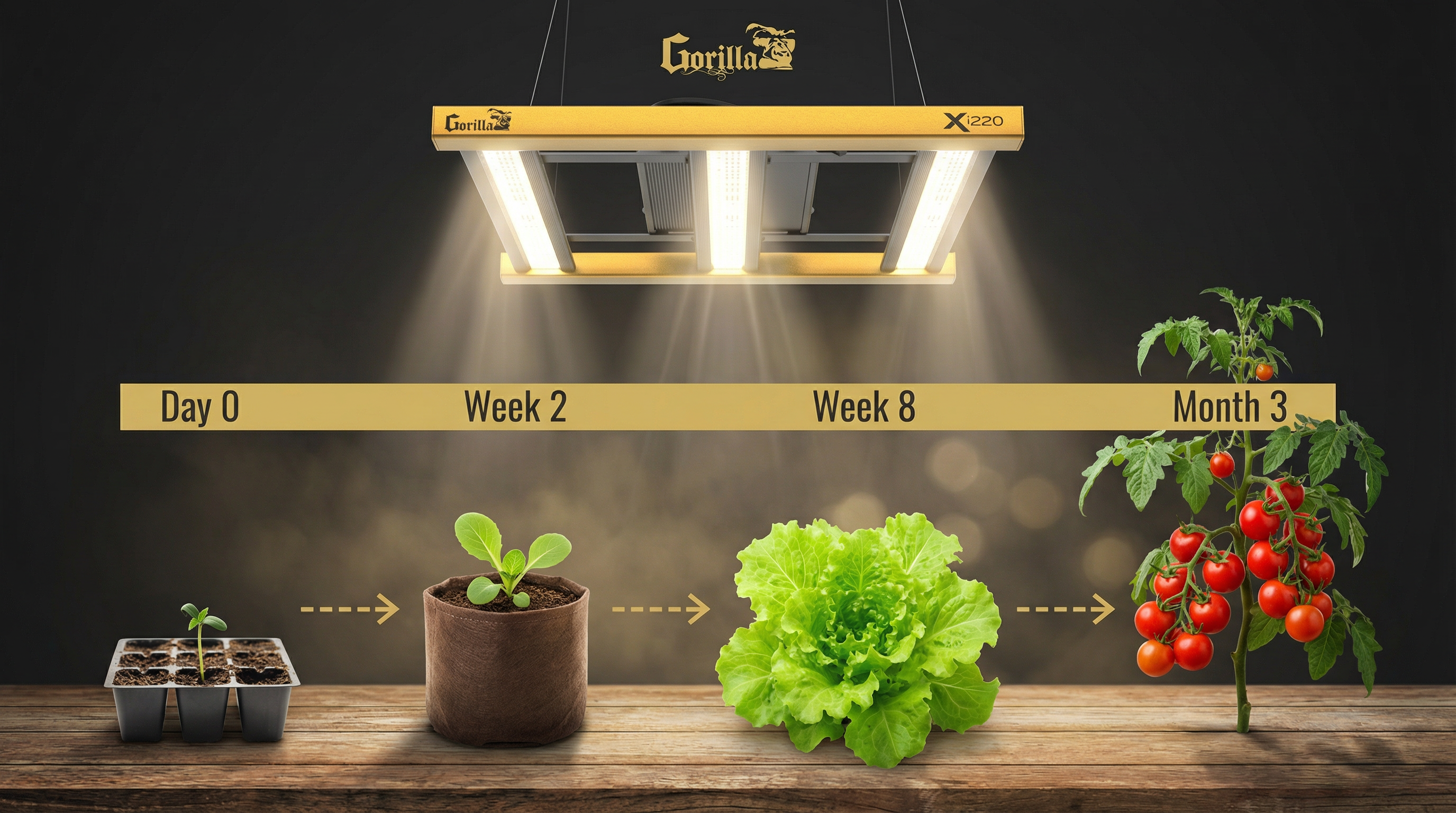
How long a plant takes to grow depends entirely on what you are growing. Microgreens are ready in 7–14 days. Lettuce heads finish in 4–6 weeks. Basil and other culinary herbs produce their first harvest in 6–8 weeks. Tomatoes and peppers need 3–5 months from seed to ripe fruit. Citrus and other fruiting trees take 2–5 years to produce.
Indoors under a full-spectrum LED with controlled temperature and humidity, the same plant grows 30–50% faster than on a windowsill and 20–30% faster than outdoors — because every variable (light, temperature, humidity, VPD, airflow) stays inside the optimal band 24 hours a day.
"How long does a plant take to grow?" sounds like a simple question but it has dozens of correct answers — one per crop. A radish is a 28-day sprint. A strawberry plant is a 9–12 month commitment before first fruit. The only thing that is universal across every plant is that indoor growing under controlled conditions is faster than any outdoor or windowsill alternative, because you eliminate the variable that slows everything down in the wild: inconsistent light and climate.
This guide breaks down realistic grow times for the most common indoor crops — microgreens, leafy greens, culinary herbs, fruiting vegetables, and houseplants — plus the four growth phases every plant goes through, the five factors that speed growth up or slow it down, and a comparison table you can bookmark.
On This Page
The 4 Universal Growth Phases
Every seed-grown plant moves through the same four stages. Duration differs by species but the sequence is universal.
Germination
Seeds absorb water, break dormancy, and push out a taproot. Warm soil (70–80°F), high humidity (70–80%), and darkness speed this up. Fresh seeds germinate in 2–5 days; old seeds may take 10–14.
Seedling Stage
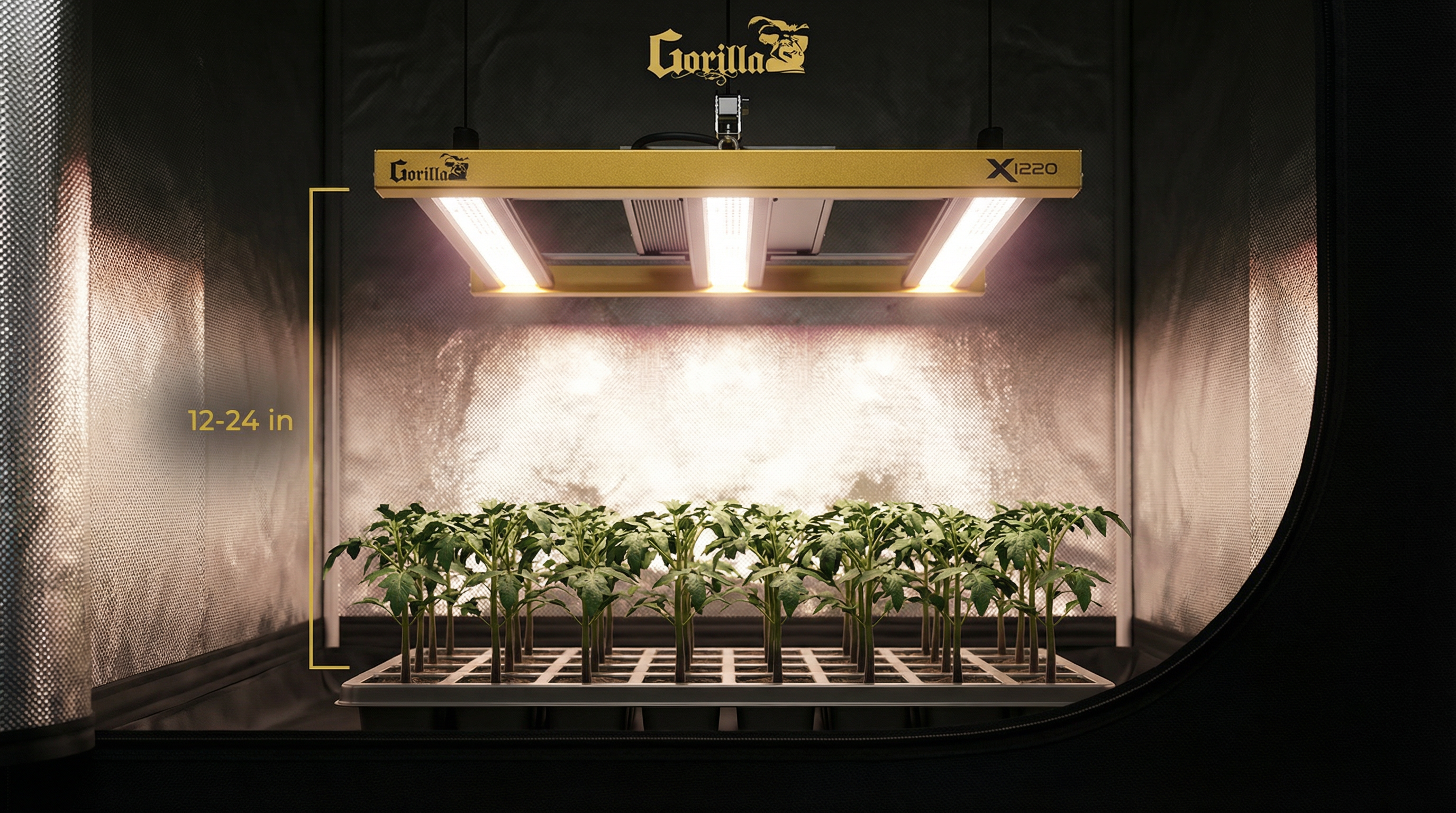
First true leaves appear, root system develops. Light demand jumps from minimal to 200–400 µmol/m²/s PPFD. Avoid leggy stretching with proper LED height.
Vegetative Growth
Leaf and stem development accelerates. Fast growers (lettuce, basil) are ready to harvest here. Slow growers (tomato, pepper) keep building structure for future fruit. PPFD target: 400–600 µmol/m²/s.
Fruiting / Reproductive Stage
Fruiting plants (tomato, pepper, cucumber, citrus) produce flowers, then fruit. Leafy greens skip this entirely. PPFD rises to 600–800 µmol/m²/s for flowering plants; most need daylength change (12 hrs or less for some, continuous for others).
How Long Each Plant Takes
Fast Crops: Under 2 Months Seed to Harvest
Microgreens
- Radish, sunflower, pea shoots: 7–10 days
- Broccoli, kale, mustard: 10–14 days
- Harvested at cotyledon stage — no true leaves needed
Lettuce (leafy)
- Cut-and-come-again: 21–28 days to first cut
- Full baby-leaf rosette: 28–35 days
- Thrives in DWC hydroponic systems
Radishes
- Cherry Belle / French Breakfast: 21–28 days
- Daikon / winter varieties: 40–60 days
- Grows in 1-gallon fabric grow bags
Arugula & Baby Greens
- Spinach, arugula, mizuna, tatsoi
- Multiple cuts from a single planting
- Prefer cooler temperatures (60–70°F)
Lettuce (head)
- Romaine, butterhead, iceberg
- Full-size heads with firm core
- Best under 14–16 hrs of LED light
Bok Choy & Pak Choi
- Baby: 30 days
- Full: 50–55 days
- Fast hydroponic crop
Medium Crops: 2–4 Months Seed to Harvest
Basil
- First harvest: 6 weeks (pinch top leaves)
- Full bush: 10–12 weeks
- Read our indoor herb garden guide
Cilantro & Parsley
- First cut: 4–6 weeks
- Cilantro bolts in heat — succession-plant every 3 weeks
- Parsley slower but longer-lived
Strawberries (from runner)
- From established plant or runner: 8–12 weeks to first fruit
- From seed: 12–18 months
- Day-neutral varieties produce all year indoors
Peppers (small)
- Hot peppers (jalapeño, chili): 70–80 days from transplant
- Bell peppers: 80–100 days
- Need 600+ µmol/m²/s PPFD
Tomatoes (cherry)
- Cherry / grape varieties: 70 days from transplant
- Requires 800+ µmol/m²/s PPFD for fruit set
- Xi420 or Xi750 LED recommended
Mint & Oregano
- Mint from cutting: 4–6 weeks to harvest
- Oregano from seed: 90 days to full plant
- Cut-and-come-again — harvests continuously
Slow Crops: 4+ Months Seed to Harvest
Tomatoes (full-size)
- Beefsteak, heirloom: 90–120 days from transplant
- Add 4–6 weeks for seed-to-transplant
- Indeterminate varieties keep producing 6+ months
Bell Peppers (full)
- Fully ripe colored bells (red, yellow): 120+ days
- Green harvest: 70–80 days
- Prefer stable 75°F and 60% humidity
Eggplant
- Italian, Japanese varieties: 70–90 days from transplant
- Needs warmer conditions than tomatoes
- High PPFD demand
Cucumbers (indoor)
- Beit Alpha / English types: 55–65 days
- Need trellis or vine support — tent height matters
- Parthenocarpic varieties produce without pollination
Rosemary
- From seed: 6–12 months to usable harvest
- From cutting: 60–90 days
- Slowest-growing culinary herb
Citrus (Lemon, Lime)
- Grafted dwarf varieties: 2–3 years to first fruit
- From seed: 5–10+ years
- See our citrus grow light guide
Houseplant Growth Rates
Ornamental houseplants are evaluated differently — you are not racing to harvest, you are watching plants put on leaves, height, or flowers. Here is what to expect.
| Plant | New Leaf Every | Mature Size (Indoor) | Years to Mature |
|---|---|---|---|
| Pothos | 2–3 weeks | 6–10 ft vine | 2–3 years |
| Monstera deliciosa | 4–6 weeks | 6–8 ft tall | 3–5 years |
| Philodendron | 2–4 weeks | varies by species | 2–4 years |
| Snake plant | 6–12 weeks (slow) | 2–4 ft tall | 5–10 years |
| Fiddle leaf fig | 4–8 weeks | 6–10 ft | 5–8 years |
| ZZ plant | 4–8 weeks | 2–3 ft | 4–6 years |
| Spider plant | 1–2 weeks (fast) | 1–2 ft rosette | 1–2 years |
| Rubber plant | 3–5 weeks | 6–10 ft | 4–6 years |
| Alocasia | 3–6 weeks | 2–4 ft | 2–4 years |
| Orchid (Phalaenopsis) | 4–8 weeks (rebloom cycles) | 12–24 in | 2–3 years for rebloom pattern |
See also: Where indoor plants grow naturally for the native climate conditions that let houseplants grow faster indoors.
5 Factors That Speed or Slow Growth
| Factor | Speeds Growth | Slows Growth |
|---|---|---|
| Light (PPFD + DLI) | Stage-appropriate PPFD, 14–18 hrs photoperiod | Low light (windowsill), wrong photoperiod, too-close LED |
| Temperature | Stable within species range (60–85°F typical) | Fluctuating temps, cold drafts, heat above 90°F |
| Humidity & VPD | Target VPD 0.8–1.2 kPa during veg | Dry winter air (20–30% RH), stagnant high humidity |
| Nutrients | Balanced NPK + micronutrients at correct stage | Deficiencies, burn, wrong pH lockout |
| Airflow | Gentle constant air movement (leaf flutter) | Stagnant air — invites disease and weak stems |
Plants grown in a properly dialed-in grow tent with full-spectrum LED consistently mature 30–50% faster than the same variety on a sunny windowsill, and 20–30% faster than the same variety outdoors in a temperate climate. The reason is time-at-optimum: your tent holds every variable inside the ideal range 24 hours a day, while outdoors and windowsills spend most of each day outside optimal.
How to Grow Plants Faster Indoors
- Full-spectrum LED at correct PPFD. Windowsills deliver 100–200 µmol/m²/s in winter. A Gorilla Xi220 delivers 600+ at 12". Your plant is photosynthesizing 3–6× faster.
- 14–16 hour photoperiod. Double the natural winter daylight. Plants with more DLI per day grow more per day.
- Stable 70–78°F. Every 10°F drop below optimum halves photosynthesis rate. A tent insulated from your home's thermostat swings holds steady.
- 60–70% humidity during veg. Higher RH reduces transpiration stress, letting plants pour energy into growth instead of water management.
- CO₂ enrichment (advanced). Ambient air is 400 ppm. Enriching to 800–1,200 ppm inside a sealed tent boosts growth rate by 20–40% for plants under high PPFD.
- Nutrient precision. Lotus Grow Pro at half strength 2x per week feeds the plant exactly what it needs during veg.
- Airflow. A smart inline duct fan keeps CO₂ fresh at every leaf and prevents stagnant-air disease.
Complete Timeline Comparison Table
| Plant | Germ. | Seedling | Veg/Fruit | Total Time |
|---|---|---|---|---|
| Microgreens (radish) | 2–3 days | — | 7–10 days | 7–14 days |
| Lettuce (baby) | 3–7 days | 1–2 wks | 2–3 wks | 28–42 days |
| Radishes | 3–7 days | 1 wk | 2–3 wks | 21–30 days |
| Lettuce (head) | 3–7 days | 2 wks | 5–6 wks | 45–55 days |
| Basil | 5–10 days | 2–3 wks | 5–7 wks | 60–90 days |
| Cilantro | 7–10 days | 2 wks | 4 wks | 45–60 days |
| Parsley | 14–21 days | 2–3 wks | 6–8 wks | 70–100 days |
| Strawberries (runner) | — | 1–2 wks | 8–12 wks | 60–90 days |
| Tomatoes (cherry) | 5–10 days | 3–4 wks | 7–9 wks | 70–100 days |
| Tomatoes (beefsteak) | 5–10 days | 4 wks | 12–16 wks | 100–140 days |
| Peppers (hot) | 7–14 days | 4–6 wks | 8–10 wks | 90–120 days |
| Bell peppers (red) | 7–14 days | 4–6 wks | 12–14 wks | 120–150 days |
| Cucumbers | 5–10 days | 2–3 wks | 5–7 wks | 55–75 days |
| Eggplant | 10–14 days | 4–6 wks | 8–10 wks | 100–130 days |
| Rosemary (seed) | 14–28 days | 4–8 wks | 20–40 wks | 6–12 months |
| Citrus (grafted) | — | 3–6 mo | 1.5–3 yrs | 2–5 years |
Indoor Setup for Faster Growth
Frequently Asked Questions
How long does it take to grow a plant from seed to harvest?
Depends on the crop. Microgreens take 7–14 days, lettuce 4–6 weeks, basil 6–8 weeks, tomatoes 3–5 months, and citrus trees 2–5 years from grafted transplant. Indoor growing under a full-spectrum LED shortens all timelines by 20–50% compared to windowsill or outdoor growing.
How long do plants take to grow indoors?
Indoor-grown plants with proper light, temperature, humidity, and nutrients grow 30–50% faster than the same crop on a windowsill and 20–30% faster than outdoor-grown plants in temperate climates. The advantage comes from stable 24/7 conditions.
How long does germination take?
3–7 days for most vegetables and herbs, 2–3 days for microgreens, and 10–14 days for slow starters like rosemary and parsley. Fresh seeds, warm soil (75–80°F), and consistent moisture speed germination.
How long does the seedling stage last?
2–4 weeks for most indoor crops. During this phase the plant develops its first true leaves and establishes roots. Light intensity matters — too little light causes leggy seedlings that take longer to recover.
How long does vegetative growth last?
For lettuce and leafy greens, vegetative stage IS the harvest (4–6 weeks total). For fruiting plants like tomatoes and peppers, vegetative growth lasts 4–8 weeks before flowering starts.
How long does fruiting take?
8–12 weeks for most fruiting vegetables (tomato, pepper, eggplant, cucumber) from the first flower to ripe fruit. Shorter for cherry tomatoes, longer for bell peppers and beefsteak tomatoes.
What is the fastest plant to grow indoors?
Microgreens — radish shoots, pea shoots, and sunflower microgreens are ready in 7–10 days. After microgreens, lettuce (4 weeks), radishes (3–4 weeks), and baby greens are the fastest.
What is the slowest plant to grow indoors?
Citrus trees and other fruiting perennials — 2–5 years from grafted transplant to first fruit, longer from seed. Rosemary is the slowest common culinary herb at 6–12 months from seed.
Do grow lights speed up plant growth?
Yes, significantly. A windowsill in winter delivers 100–300 µmol/m²/s PPFD. A proper LED delivers 400–800 µmol/m²/s for 14–16 hours per day. Plants photosynthesize 3–6× faster and mature 30–50% quicker under a real grow light.
How much faster does hydroponics grow plants?
Leafy greens (lettuce, spinach, basil) grow 30–50% faster in deep water culture or ebb-and-flow systems than in soil, because roots get unrestricted oxygen and nutrients. Fruiting crops see smaller gains but better yield quality.
Related Guides
Keep learning: Indoor Herb Garden Setup · Leggy Seedlings Fix · Grow Lights for Seedlings · VPD Chart · Where Indoor Plants Grow Naturally
Cut Your Grow Time by 30–50%
A proper grow tent plus full-spectrum LED holds every growth variable inside the optimum — so plants spend 24 hours a day in the zone instead of just a few.