PPFD for Seedlings: Exact Targets by Stage + Calculator
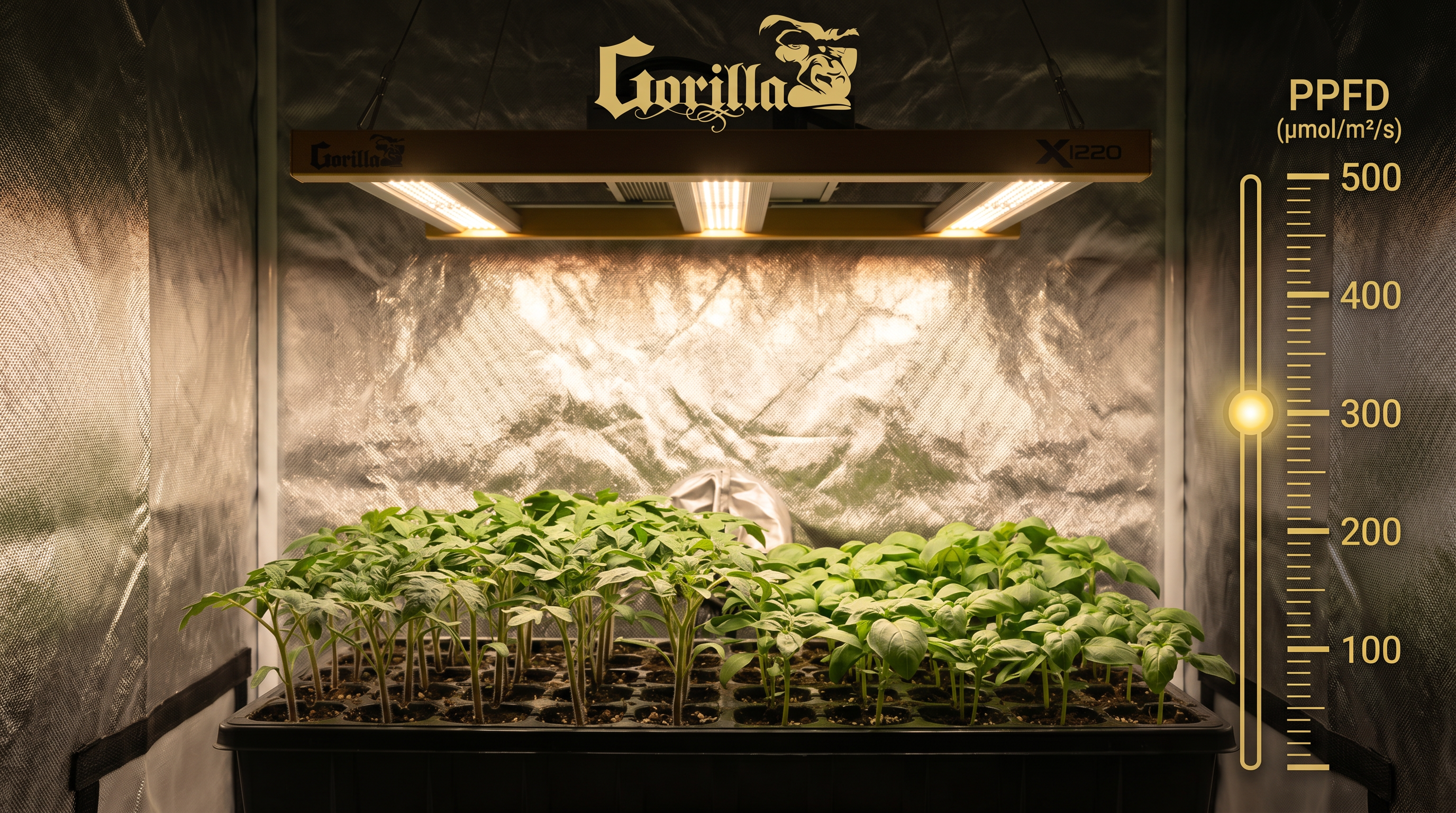
Seedlings need much less PPFD than mature plants. Start freshly germinated seedlings at 100–200 µmol/m²/s, ramp to 200–300 µmol/m²/s when cotyledons open, 300–400 µmol/m²/s at first true leaves, and 400–500 µmol/m²/s by transplant. Run 14–16 hours per day.
Too much PPFD bleaches leaf tops. Too little causes leggy stretching. Use a dimmable LED like the Gorilla Xi220 to dial intensity down to 30–40% for day-one seedlings, then ramp up as they mature.
Getting PPFD right is the difference between short, stocky, transplant-ready seedlings and pale, stretched ones you have to restart. Unlike mature plants that want 600–1,000 µmol/m²/s, seedlings are fragile — too much intensity bleaches their cotyledons, and too little triggers etiolation (stretching). This guide gives you exact PPFD targets by stage, a calculator to match your LED and dim setting to the right intensity, and the setup that prevents both problems.
On This Page
- What Is PPFD and Why It Matters for Seedlings
- PPFD Targets by Seedling Stage
- PPFD Calculator: Which Dim Setting for My LED?
- Daily Light Integral (DLI) for Seedlings
- Best LED PPFD by Tent Size
- Too Much vs Too Little PPFD
- How to Ramp PPFD as Seedlings Grow
- Complete Seedling Station Setup
- Frequently Asked Questions
What Is PPFD and Why It Matters for Seedlings
PPFD (Photosynthetic Photon Flux Density) measures how many photons of photosynthetically-useful light hit a square meter per second, in micromoles (µmol/m²/s). It is the only light metric that matters for plant growth — lumens, watts, and lux measure things relevant to human eyes, not photosynthesis.
Seedlings are fragile. Their cotyledons (seed leaves) lack the protective wax cuticle that mature leaves develop, so high PPFD bleaches them white and stunts growth. But too little PPFD triggers etiolation — the plant stretches upward hunting for brighter light it cannot find, producing thin, weak stems that collapse at transplant. The sweet spot is a moderate, steady PPFD that rises as the plant matures.
PPFD Targets by Seedling Stage
| Stage | Age | PPFD Target | DLI Target | Photoperiod |
|---|---|---|---|---|
| Germination | Days 0–7 (pre-sprout) | 100–200 µmol/m²/s | 5–10 mol/m²/day | 14 hrs |
| Cotyledon / sprout | Week 1–2 | 200–300 µmol/m²/s | 10–14 mol/m²/day | 14–16 hrs |
| First true leaves | Week 2–3 | 300–400 µmol/m²/s | 14–18 mol/m²/day | 14–16 hrs |
| Transplant-ready | Week 3–4 | 400–500 µmol/m²/s | 18–22 mol/m²/day | 14–16 hrs |
A seedling at day 1 exposed to mature-plant PPFD (800+ µmol/m²/s) bleaches in 48 hours. The same seedling three weeks later welcomes that intensity. Ramping — via dimming, not distance — is how one LED serves every stage.
PPFD Calculator: Which Dim Setting for My LED?
Find Your PPFD
Pick your Xi LED, hang distance, and dim setting. Result = estimated PPFD at canopy center.
Daily Light Integral (DLI) for Seedlings
PPFD is instantaneous — how much light is hitting plants right now. DLI (Daily Light Integral) is the total accumulated light over a 24-hour period, measured in mol/m²/day. It is what actually drives growth: plants care about daily total, not just peak intensity.
DLI formula: DLI = PPFD × (3600 × photoperiod_hours / 1,000,000)
Example: seedlings at 300 µmol/m²/s for 16 hours = 17.3 mol/m²/day DLI — perfect for true-leaf stage.
| Seedling Stage | PPFD | Hours | Resulting DLI |
|---|---|---|---|
| Germination | 150 µmol/m²/s | 14 hrs | 7.6 mol/m²/day |
| Cotyledon | 250 µmol/m²/s | 16 hrs | 14.4 mol/m²/day |
| True leaves | 350 µmol/m²/s | 16 hrs | 20.2 mol/m²/day |
| Transplant-ready | 450 µmol/m²/s | 16 hrs | 25.9 mol/m²/day |
Best LED PPFD by Tent Size
| Tent | LED Pick | PPFD at 18" (100%) | Seedling-Stage Dim |
|---|---|---|---|
| 2x2 seedling station | Xi220 ($495) | ~270 µmol/m²/s | 50–70% for true leaves |
| 2x4 seedling rack | Xi220 | ~270 µmol/m²/s center | 70–100% |
| 3x3 mixed stage tent | Xi330 ($595) | ~360 µmol/m²/s | 40–60% for seedlings |
| 4x4 production tent | Xi420 ($695) | ~450 µmol/m²/s | 30–40% for seedlings |
Too Much vs Too Little PPFD
| Symptom | Cause | Fix |
|---|---|---|
| Bleached white leaf tops | PPFD too high for stage | Dim 20–30% or raise LED 4–6 inches |
| Curled "tacoed" leaves pointing up | PPFD + heat stress | Dim 30% + add airflow |
| Tall, leggy, stretched stems | PPFD too low | Raise dim 20% or lower LED 4 inches — see leggy seedlings fix |
| Pale light-green color | PPFD too low (or nitrogen deficiency) | Raise PPFD first; then feed if no improvement in 5 days |
| Slow/no growth despite adequate water/nutrients | Insufficient DLI | Raise PPFD OR extend photoperiod to 16 hrs |
| Crispy brown leaf edges | PPFD too high at close distance | Raise LED 6 inches, dim 40% |
How to Ramp PPFD as Seedlings Grow
- Day 1–3 (pre-sprout): LED at 24", dim 30–40% → ~100–150 PPFD at soil
- Day 4–10 (cotyledon): LED at 20", dim 50–60% → ~200–250 PPFD
- Week 2–3 (true leaves): LED at 18", dim 70–80% → ~300–400 PPFD
- Week 3–4 (transplant-ready): LED at 15", dim 90–100% → ~450–500 PPFD
- Post-transplant (vegetative): LED at 14", dim 100% → ~600+ PPFD
Changing distance forces the plant to re-adapt to new light angle and coverage. Dimming keeps the LED position static while scaling intensity — smoother transitions, happier plants. See our distance chart for exact hang heights.
Complete Seedling Station Setup
Frequently Asked Questions
What PPFD do seedlings need?
100–200 µmol/m²/s during germination, 200–300 at cotyledon stage, 300–400 once true leaves emerge, 400–500 by transplant-ready. Run 14–16 hours per day.
Can PPFD be too high for seedlings?
Yes. PPFD above 500 µmol/m²/s bleaches young cotyledons and curls true leaves. Always dim LEDs for seedlings — 30–50% for the first 2 weeks.
How do I measure PPFD without a PAR meter?
Use manufacturer PPFD-at-distance charts for your specific LED (e.g. Xi220 delivers 600 µmol/m²/s at 12 inches). Or use the PPFD calculator above — it estimates from model, distance, and dim setting.
What DLI do seedlings need?
5–10 mol/m²/day during germination, 10–14 at cotyledon stage, 14–18 at true leaves, 18–22 by transplant. Photoperiod × PPFD = DLI.
How many hours of light do seedlings need?
14–16 hours per day with 8–10 hours of darkness. Avoid 24-hour lighting — seedlings need dark-period metabolism to build strong stems.
Is 400 PPFD too much for seedlings?
Not for seedlings with true leaves (week 2+). It is too much for freshly sprouted cotyledons — start lower (150–250) and ramp up as plants develop.
Why are my seedlings stretching even under a grow light?
Three possibilities: PPFD too low (dim up or lower light), photoperiod too short (run 14–16 hrs), or red-heavy spectrum without enough blue. Full fix: leggy seedlings guide.
Should I dim my LED for seedlings?
Yes. Most full-power LEDs deliver 600+ µmol/m²/s at 12 inches — way too much for seedlings. Dim to 30–50% for the first 2 weeks, then ramp to 80–100% by transplant-ready.
What is the best LED for seedling PPFD?
A dimmable full-spectrum LED. The Gorilla Xi220 covers a 2x2 to 3x3 seedling station and dims cleanly from 30% (seedling start) to 100% (transplant-ready). One LED handles every stage.
Does PPFD matter more than photoperiod?
Both matter — together they form DLI, which is what actually drives growth. But PPFD dictates whether plants burn or stretch, while photoperiod sets the daily total. Get PPFD right first, then extend photoperiod to hit your DLI target.
Related Guides
Keep learning: Leggy Seedlings Fix · Grow Lights for Seedlings · LED Distance Chart · UV Light for Plants · VPD Chart
Dial In Seedling PPFD
A dimmable Xi220 LED plus a reflective 2x2.5 tent gives you every PPFD level from day-one germination to transplant-ready — no light upgrades needed.