Grow Lights for Seedlings: Pick the Right One (No More Leggy Stretching)
The best grow lights for seedlings are full-spectrum LEDs with dimming control that deliver 200–400 µmol/m²/s PPFD at canopy and give you precise hang-height control. A windowsill is rarely enough in winter; a cheap "red-and-blue" LED produces pale, stretched seedlings; and a 600W flagship at full power will burn them.
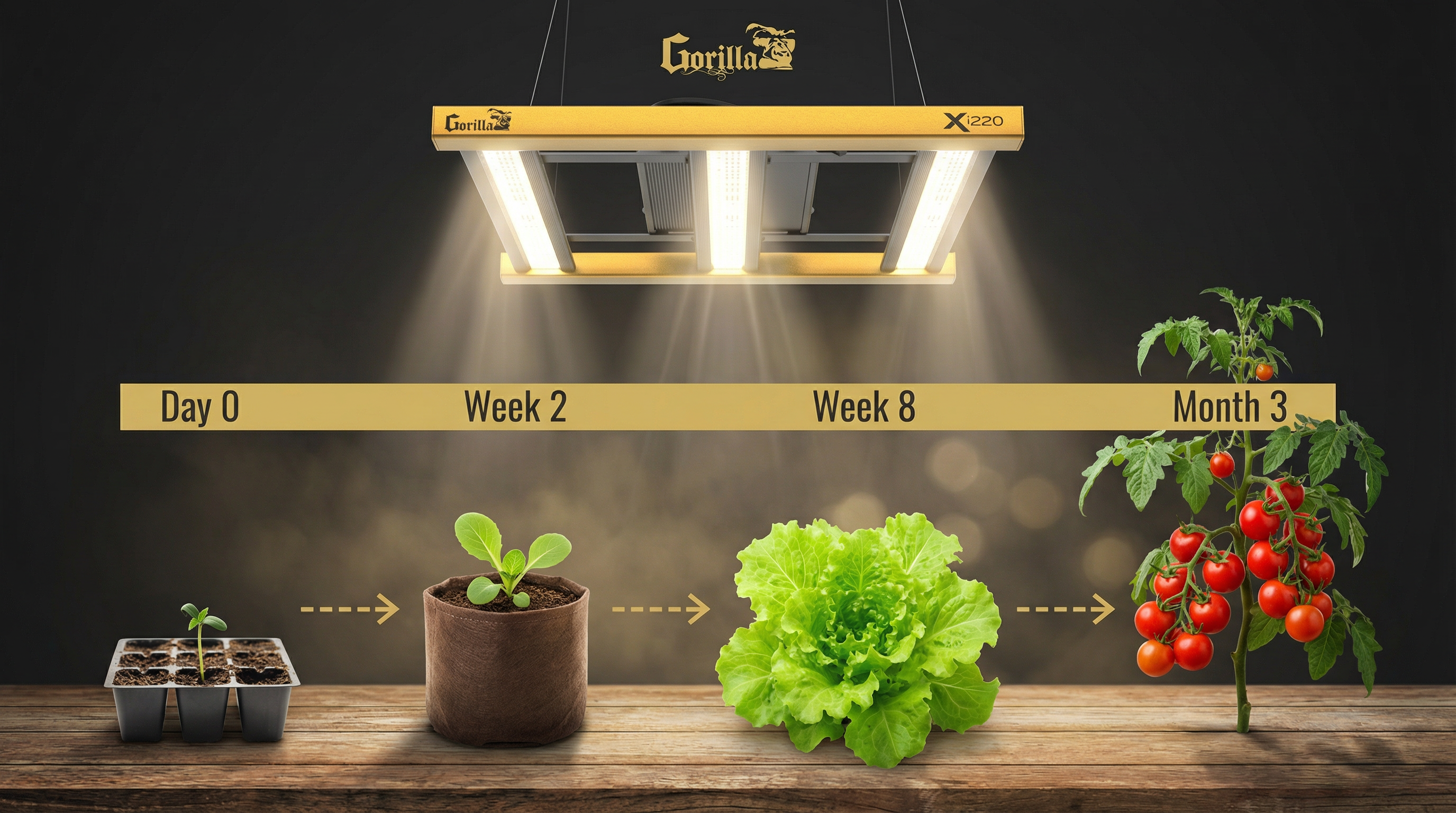
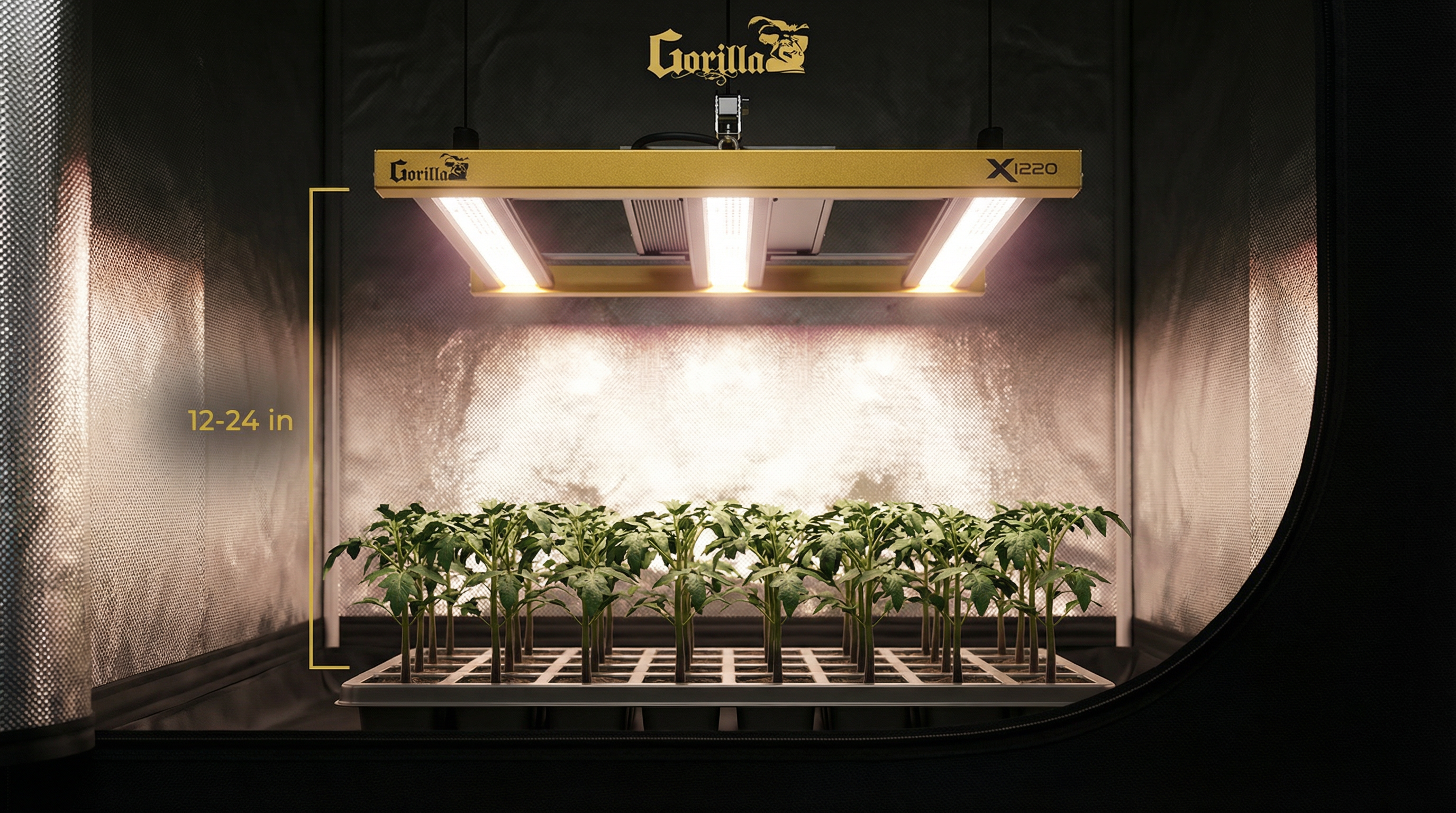
Hit this target and your seedlings stay short, stocky, and dark green: 14–16 hours of full-spectrum light per day at 12–24 inches above the canopy, with the LED dimmed to match each growth stage. The Gorilla Xi220 LED is the one grow light in our lineup built exactly for this — it dims cleanly from 30% (seedling) to 100% (transplant-ready) and covers a 2x2 to 3x3 footprint with tri-channel spectrum control.
Choosing the right grow light for seedlings is the single biggest decision between stocky, transplant-ready starts and pale, stretched ones you have to toss. This guide covers exactly what PPFD, DLI, spectrum, and hang height seedlings need, why a proper LED beats every alternative, and which specific model to buy at each budget. If your seedlings are already leaning or stretched, start with our companion guide on fixing leggy seedlings first.
On This Page
- Why Seedlings Need a Real Grow Light
- What Makes a Grow Light "Right" for Seedlings
- PPFD & DLI Targets by Seedling Stage
- Spectrum: Full-Spectrum vs Red/Blue
- How Many Hours of Light Do Seedlings Need?
- Hang Height & Distance Chart
- Best Grow Light for Seedlings (by Tent Size)
- Why Cheap Grow Lights Fail Seedlings
- Seedling Station: 5-Step Setup
- Common Mistakes & Fixes
- Frequently Asked Questions
Why Seedlings Need a Real Grow Light
Outdoors, sunlight at noon on a clear summer day delivers about 2,000 µmol/m²/s PPFD at ground level. A bright south-facing windowsill in winter, through double-pane glass, delivers 100–300 µmol/m²/s — and only for a few hours when the sun actually reaches it. That's why every windowsill seed-starting attempt above 35° latitude produces leggy, leaning seedlings from January through April.
A full-spectrum LED grow light fixes this in one stroke: it holds steady 200–400 µmol/m²/s at canopy height for 14–16 hours per day, regardless of weather, time, or season. The result is short, thick, uniform seedlings with dark green leaves and vigorous roots — exactly what survives the shock of transplant.
A controlled full-spectrum LED at the right PPFD produces seedlings with 2–3× the root mass and 30–50% thicker stems compared to windowsill starts. That's not a marketing claim — it's repeatable across every major horticultural study in the last decade.
What Makes a Grow Light "Right" for Seedlings
Most "grow light" products on Amazon fail seedlings because they're optimized for mature plants — high intensity, narrow spectrum, fixed output. Seedlings want the opposite: moderate intensity, broad spectrum, and dimming control so the same light grows with them. Here's the spec sheet that matters.
| Feature | What You Want | Why It Matters |
|---|---|---|
| Full spectrum | White light (3000K or 3500K base) + red and blue supplemental | Balanced spectrum prevents both stretching and bleaching |
| Dimmer | 0–100% continuous | Same light runs at 30% for day-1 seedlings and 100% for mature plants |
| PPFD at 18" | 300–500 µmol/m²/s at center | Gives 200–400 at canopy with room to dim down |
| Efficacy | ≥ 2.5 µmol/J | Lower wattage for the same output = lower heat + lower electric bill |
| Coverage | Matches your tent/tray footprint | Uniform PPFD across the whole canopy — no shadow corners |
| App control | Schedule, dim, spectrum tuning | Automate the 14–16 hour cycle without a separate timer |
| Build quality | Aluminum heatsink, IP rating, 3+ year warranty | Runs cooler, lasts longer, doesn't flicker under variable RH |
PPFD & DLI Targets by Seedling Stage
Seedlings don't need the same intensity as mature plants — they actually do better at moderate PPFD with longer exposure. Use these targets to dial in your LED. (PPFD = intensity at a single moment. DLI = total daily light.)
| Stage | PPFD Target | DLI Target | Photoperiod |
|---|---|---|---|
| Germination (pre-sprout, soil phase) | 100–200 µmol/m²/s | 5–10 mol/m²/day | 14 hrs |
| Cotyledon stage (first round seed leaves) | 200–300 µmol/m²/s | 10–14 mol/m²/day | 14–16 hrs |
| First true leaves | 300–400 µmol/m²/s | 14–18 mol/m²/day | 14–16 hrs |
| Transplant-ready seedling | 400–500 µmol/m²/s | 18–22 mol/m²/day | 14–16 hrs |
The Xi220 at full power delivers 600+ µmol/m²/s at 12" — enough to burn a cotyledon. Dim it to 30% and you hit 180 µmol/m²/s, the sweet spot for day-one seedlings. As the plant matures, you raise the dim percentage instead of buying a new light. One LED, every stage.
Spectrum: Full-Spectrum vs Red/Blue
Early grow lights used pure red + blue LEDs because they're the two wavelengths chlorophyll absorbs most. That works, but it makes seedlings spindly and makes it impossible to see plant health (everything looks purple). Modern full-spectrum LEDs include white diodes across 3000–6000K, plus supplemental far-red and deep-blue — which mimics sunlight and produces stockier seedlings with better root development.
For seedlings specifically, you want 15–25% blue light (400–500nm). Blue suppresses stem elongation and promotes short, bushy growth. A red-heavy LED with no blue will stretch seedlings even at correct intensity — one of the most common causes of legginess under an LED.
How Many Hours of Light Do Seedlings Need?
Run lights 14–16 hours on, 8–10 hours off. That's the sweet spot for almost every common garden seedling — tomatoes, peppers, basil, brassicas (broccoli, cabbage, kale), lettuce, parsley. Don't run 24-hour light; seedlings actually need a dark period to consolidate growth hormones and strengthen stems.
| Plant Type | Daily Light Cycle | Notes |
|---|---|---|
| Tomato, pepper, eggplant | 14–16 hrs on / 8–10 off | Bolt less under a consistent schedule |
| Basil, parsley, cilantro (herbs) | 14–16 hrs on / 8–10 off | See our indoor herb garden guide |
| Brassicas (broccoli, cabbage, kale) | 14 hrs on / 10 off | Prefer slightly shorter photoperiod |
| Lettuce, spinach, leafy greens | 14–16 hrs on / 8–10 off | Higher DLI = faster heads |
| Microgreens | 14–16 hrs on / 8–10 off | Shorter days also work — 10–12 hrs |
Hang Height & Distance Chart
Distance matters more than people think — PPFD falls off with the square of distance. A light at 12" delivers 4× the intensity it does at 24". Use this chart for the Gorilla Xi220 LED:
| Stage | Xi220 at 100% | Xi220 at 50% | Too-Close Warning Sign |
|---|---|---|---|
| Seeded tray (pre-sprout) | 24" above soil | 18" above soil | Soil surface drying in < 2 hrs |
| Just sprouted | 18–24" above tops | 12–18" above tops | Bleached, white leaf tops |
| Cotyledons fully open | 15–20" above tops | 10–15" above tops | Curling ("tacoed") leaves |
| First true leaves | 12–18" above tops | 10–12" above tops | Crispy leaf edges, heat damage |
| Transplant-ready | 10–14" above tops | 8–12" above tops | Excessive transpiration, leaf curl |
Hold the back of your hand at canopy height for 60 seconds. If it feels uncomfortably warm, raise the light. If it feels cool with just a touch of warmth, you're in the right zone. Works for any LED, no meter required.
Best Grow Light for Seedlings by Tent Size
Gorilla Xi220 LED
$495.00The right grow light for most home seedling stations. Dims cleanly 0–100%, covers a 2x2 to 3x3 footprint at 600+ µmol/m²/s peak, tri-channel spectrum (warm white + cool white + red) via app. One light takes a tray from day-one germination to transplant-ready.
Shop Xi220 →Xi220 + 2x2.5 Pro Tent
$664.90Paired bundle for a closet or pantry seedling station. 1680D canvas tent with diamond-reflective interior + dimmable Xi220 = every watt hits the canopy. Enough for 4–6 seed flats.
Shop 2x2.5 Pro →Xi220 + 2x4 Pro Tent
$734.90Wide rectangular footprint, perfect for starting a full season of tomato, pepper, and brassica seedlings. One Xi220 covers the tray area at dimmed power, then ramps to 100% once seedlings enter true-leaf stage.
Shop 2x4 Pro →Xi220 + 3x3 Pro Tent
$744.909 sq ft seedling nursery. Fits 12–18 seed flats depending on layout — enough for a market garden or CSA start. Xi220 at 100% covers a 3x3 footprint for seedling-stage PPFD.
Shop 3x3 Pro →Why Cheap Grow Lights Fail Seedlings
Every gardener who's started seeds indoors has been tempted by a $45 Amazon "1000W" LED. Here's why almost every one of them produces leggy, bleached, or heat-stressed seedlings:
- Wattage is marketed, not measured. A "1000W" light pulls 100–120W from the wall. The number is meaningless.
- No dimming. Full blast on cotyledons = bleached white leaves in three days.
- Narrow spectrum. Red + blue only produces stretched, spindly growth no matter how close you hang it.
- Poor heat management. Aluminum sinks too thin — lights fail or dim permanently within 6 months.
- No warranty. When they fail, you're on your own.
The math: a $45 failing LED costs $45. A $495 Xi220 grows seedlings for 10 years. Per season, the Xi220 is cheaper — and you don't lose a crop of tomato starts to a bleached light.
Seedling Station: 5-Step Setup
Assemble tent & hang the LED
Set up a 2x2.5 Pro or 3x3 Pro tent in a stable 65–70°F room. Mount the Xi220 at 24" above the tent floor using the included ratchet hangers.
Set the photoperiod to 14–16 hours
Use the Gorilla Grow Tent App to schedule lights-on for morning and lights-off 14–16 hours later. Keep the schedule consistent day-to-day.
Dim to 30–40% for germination
Start low. Heat mats go under trays during germination only — remove them the moment sprouts break the soil.
Lower the LED as seedlings grow
Once cotyledons open, lower the light to 15–20" or raise dim to 60%. At first true leaves, drop to 12–18" or 80%. At transplant-ready, you can run 100% at 10–14".
Add airflow and watch for stretch
A 6-inch Smart Inline Fan at low speed strengthens stems. If seedlings lean or stretch, drop the light 3–4" and check your dim percentage.
Common Mistakes & Fixes
| Mistake | Result | Fix |
|---|---|---|
| LED too high or too dim | Leggy, stretched seedlings | Lower to 12–18" or raise dim to 60–80% |
| LED too close at full power | Bleached white tops, curled leaves | Raise 4–6" or dim to 40–60% |
| Heat mat left on after germination | Rapid stem elongation | Unplug mat once sprouts emerge |
| No airflow | Thin weak stems, damping-off disease | Add a small oscillating or inline fan |
| 24-hour light cycle | Stressed seedlings, no dark recovery | Set a 14–16 hour timer with 8–10 hour dark |
| Mixing light sources (window + LED) | Seedlings lean toward stronger side | Close blinds or use LED alone |
| Using red-heavy "purple" LED only | Spindly, stretched growth | Switch to full-spectrum white-based LED |
Starter Kit: Seedling Station Essentials
Frequently Asked Questions
What kind of grow light is best for seedlings?
A full-spectrum LED with dimming control that delivers 200–400 µmol/m²/s PPFD at canopy. The Gorilla Xi220 covers a 2x2 to 3x3 footprint, dims cleanly across every seedling stage, and uses tri-channel spectrum to produce short, stocky, dark green starts.
How many watts does a grow light need for seedlings?
A 2x2 seedling tray needs about 80–120 actual watts of a quality full-spectrum LED (not "marketed" watts). The Xi220 pulls 220W at the wall at 100% and dims down to 30–40% for seedling-stage PPFD.
How far should a grow light be from seedlings?
18–24 inches at full power for freshly sprouted seedlings, lowering to 12–18 inches as plants develop true leaves. A dimmable LED can sit closer (10–14 inches at 50% output) because you reduce intensity, not distance.
How much light do seedlings need per day?
14–16 hours of full-spectrum light, with 8–10 hours of darkness. Run a consistent schedule — seedlings stretch less under stable daily photoperiods than under variable or 24-hour lighting.
What PPFD do seedlings need?
100–200 µmol/m²/s during germination, 200–400 µmol/m²/s at cotyledon stage, 300–500 µmol/m²/s once true leaves emerge. Use a PAR meter or trust the LED manufacturer's PPFD-at-distance specs.
Can seedlings grow under a regular LED bulb?
No. Regular household LEDs have no measurable PAR output — they're engineered for human eye visibility, not photosynthesis. You'll produce pale, weak, leggy plants that collapse at transplant.
Are purple (red + blue) grow lights good for seedlings?
They work but produce spindlier, stretchier seedlings than full-spectrum white-based LEDs. They also make it impossible to see plant health — pale leaves, nutrient deficiencies, and early pest damage are invisible under purple light. Full-spectrum is the modern standard.
Do I need a grow tent to start seeds?
Not strictly — but an open rack loses 40–60% of your LED's light to the room and exposes seedlings to pet dander, dust, aphids, and temperature swings. A reflective tent delivers more usable light per watt and keeps seedlings clean. Any 2x2 or 3x3 grow tent works.
When should I turn up the dim setting?
Ramp intensity with growth: 30–40% at day 1, 50–60% once cotyledons open, 70–80% at first true leaves, 90–100% at transplant-ready. If seedlings show any bleaching or curl, pull back 20%.
Can I use the same grow light for seedlings and mature plants?
Yes — that's the advantage of a dimmable full-spectrum LED. The Xi220 runs at 30% for seedlings and 100% for mature herbs or vegetables in the same tent. One light, every growth stage, no upgrade cycle.
Related Guides
Keep learning: Leggy Seedlings: How to Fix & Prevent · Indoor Herb Garden Setup · 4x4 vs 5x5 Grow Tent · VPD Chart
Stop Losing Seedlings to Bad Light
The right LED + tent combination pays back in a single season of not replacing stretched or bleached transplants. Start stocky, transplant successfully.