Indoor Herb Garden: Complete Setup Guide for Year-Round Fresh Herbs
An indoor herb garden is a small, climate-controlled growing area where you raise culinary herbs like basil, thyme, rosemary, mint, and cilantro year-round — independent of season, weather, or outdoor space. The fastest path to fresh herbs every week is a small grow tent (2x2.5 or 2x4), a full-spectrum LED grow light, and a basic watering + nutrient routine.
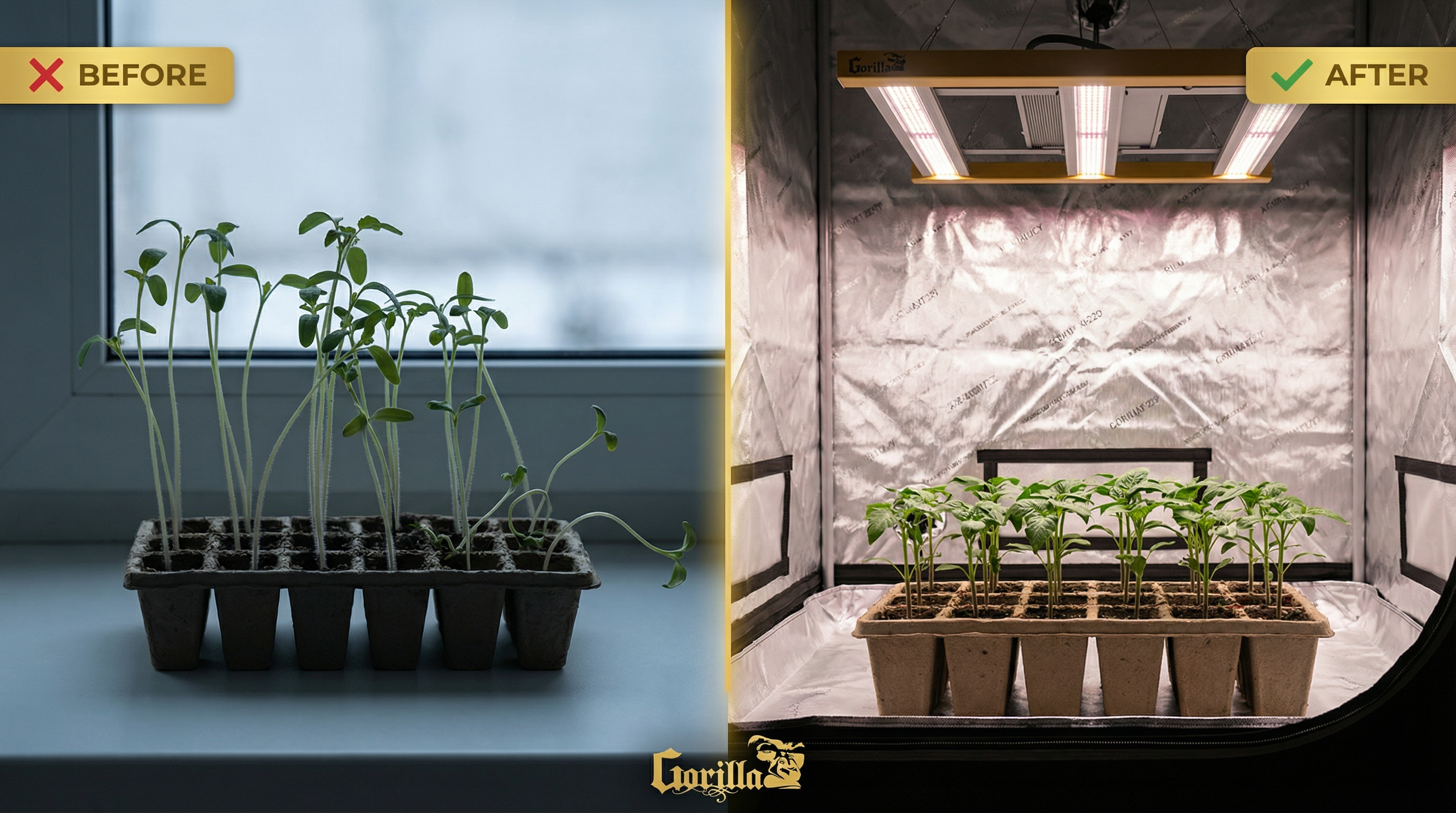
Most popular herbs want 14–16 hours of light per day, a daily light integral (DLI) of 12–20 mol/m²/day, 65–75°F, and 50–60% relative humidity. That's easy to hit inside a grow tent — impossible on a winter windowsill.
A productive indoor herb garden does three things a kitchen windowsill cannot: it delivers enough light for dense, aromatic growth in the darkest months, holds stable temperature and humidity regardless of weather, and keeps pests and diseases out of your food. This guide walks through every choice that matters — the 10 best herbs to grow indoors, what size grow tent you need, the right grow lamp for herbs, watering and nutrient basics, and a simple 5-step setup that takes a weekend.
On This Page
- Why Grow Herbs Indoors?
- 10 Best Herbs for Indoor Growing
- What Size Grow Tent Do You Need?
- Grow Lamp for Herbs: Spectrum, DLI & Distance
- 5-Step Indoor Herb Garden Setup
- Watering & Nutrients
- Temperature & Humidity Targets
- Harvesting for Continuous Yield
- Common Problems & Fixes
- Hydroponic Herbs & Lettuce
- Recommended Starter Setup
- FAQ
Why Grow Herbs Indoors?
Outdoor herbs stop producing the moment frost hits. Grocery-store herbs wilt in three days and cost $3 for a palmful. An indoor herb garden solves both problems and adds a third benefit most growers don't expect: the flavor concentration of a high-DLI indoor herb is noticeably stronger than anything you'll buy in the produce aisle, because you control the light spectrum and nutrient profile that drive essential-oil production.
- Year-round harvest — basil, thyme, rosemary, and mint grow continuously under a 14–16 hour light cycle.
- Kitchen-adjacent convenience — a 2x2 grow tent fits in a pantry, closet, or corner of the kitchen.
- Higher flavor — full-spectrum LEDs with red-to-blue ratios tuned for leafy growth trigger stronger aromatic oils than natural light alone.
- No pesticides — enclosed tents keep aphids, whiteflies, and fungus gnats out.
- Lower cost over time — one basil plant under a grow light yields more than you'd buy in a year.
10 Best Herbs for Indoor Growing
Not every culinary herb adapts to indoor life. Some want a sprawling outdoor root zone (lovage, lemongrass); others sulk without intense direct sun (rosemary needs a strong LED). These ten are the most productive, forgiving, and flavor-dense herbs for an indoor grow tent or windowsill garden.
🌿 Basil
The #1 indoor herb. Loves warmth and high DLI. Pinch flower buds to keep leaves producing. Harvest every 2 weeks.
🌱 Thyme
Wants bright light and dry-ish soil. Water when top inch is fully dry. Trim woody stems monthly.
🌲 Rosemary
Needs the strongest LED of any herb — aim for 600 µmol/m²/s PPFD. Prefers cool nights and excellent drainage.
🌿 Mint
Aggressive grower. Keep in its own pot or it takes over. Harvest leaves before flowering for peak flavor.
🌿 Cilantro / Coriander
Bolts fast in heat. Succession-plant every 3 weeks for continuous harvest. Lower DLI than basil.
🌿 Parsley
Flat-leaf varieties are more productive indoors than curly. Slow germination — start 4 weeks ahead.
🌿 Oregano
Greek oregano is the most flavorful. Wants bright light and well-drained media. Harvest before flowering.
🌿 Chives
Easiest indoor herb. Cut to 2" above soil — regrows in 2 weeks. Tolerates lower DLI than most.
🌿 Sage
Slow grower. Needs bright light and space. Don't overwater — sage hates wet feet.
🌿 Dill
Tall grower — needs a tent with vertical clearance. Succession-plant every 4 weeks for continuous leaves.
What Size Grow Tent Do You Need?
For an indoor herb garden, smaller is better. Herbs need less canopy per plant than fruiting crops, and a compact tent is cheaper to light, ventilate, and keep in a spare room or pantry. Use this sizing guide to match footprint to your planned herb count.
An open shelf loses 40–60% of the LED's light output to the room — and lets moisture, pests, and pet dander in. A reflective grow tent bounces all light back onto the canopy (faster growth, lower electric bill), isolates humidity and temperature, and keeps the system clean. Gorilla Grow Tent Pro models use 1680D canvas and diamond-reflective interior lining for maximum efficiency.
Grow Lamp for Herbs: Spectrum, DLI & Distance
The single biggest lever in an indoor herb garden is the grow lamp for herbs. Herbs don't need the same intensity as flowering crops, but they do need full-spectrum light with enough blue (400–500nm) to drive compact, aromatic leaf growth and enough red (600–700nm) to support healthy stems.
| Herb Type | PPFD Target | DLI Target | Recommended LED |
|---|---|---|---|
| Low-intensity (chives, parsley, cilantro, mint) | 200–400 µmol/m²/s | 12–18 mol/m²/day | Gorilla Xi220 at 30–50% dim |
| Medium-intensity (basil, oregano, dill) | 300–500 µmol/m²/s | 16–22 mol/m²/day | Gorilla Xi220 at 60–80% |
| High-intensity (rosemary, thyme, sage) | 400–600 µmol/m²/s | 20–25 mol/m²/day | Gorilla Xi220 at 80–100% |
The Gorilla Xi220 LED Grow Light covers a 2x2 to 3x3 footprint at full power and is app-dimmable via the Gorilla Grow Tent App — so you can run it at 40% for a chives-and-parsley tent or 100% for a rosemary-heavy setup. Tri-channel spectrum control lets you shift red/blue ratios across growth stages.
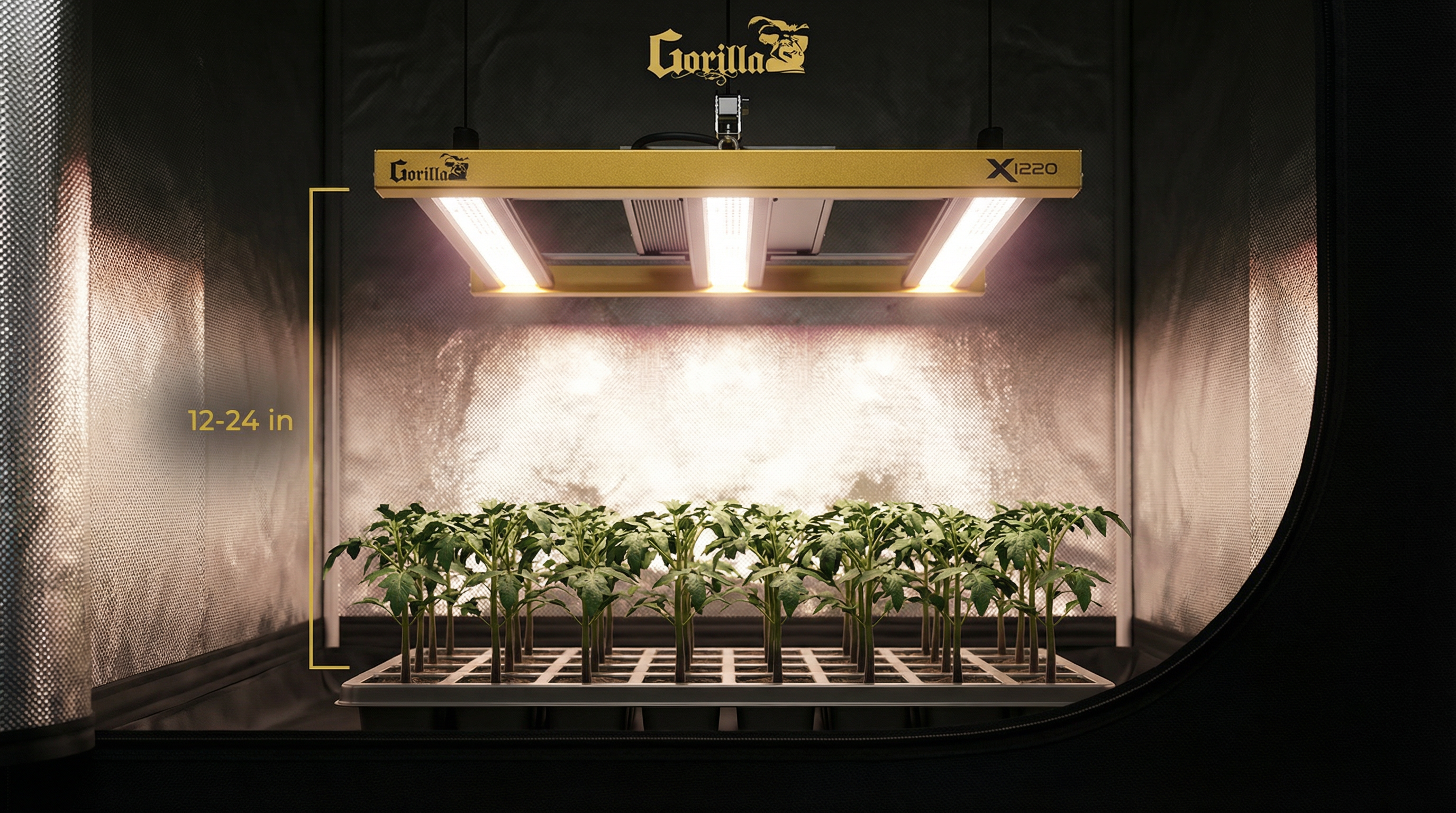
Start the LED at 18–24 inches above the canopy for seedlings and young herbs. Lower to 12–18 inches once plants are established and leaves are dense. If you see pale, bleached tops, raise the light 4 inches. If plants stretch tall and leggy, lower it 4 inches.
5-Step Indoor Herb Garden Setup
Assemble the grow tent
Stand the frame in your chosen room, clip canvas to the poles, and set the floor tray. A Gorilla Pro 2x2.5 or 2x4 takes 20 minutes with the included instructions.
Hang the LED and connect fan
Use the ratchet hangers to mount the Xi220 LED 18–24 inches above the tent floor. Connect a smart inline duct fan at the top exhaust port to pull warm air out.
Plant starts or seeds into pots or grow bags
Use 1–3 gallon fabric grow bags with a well-drained potting mix (coco coir + perlite, or a quality soilless blend). Space plants 6–8 inches apart.
Set light timer & climate targets
Program the LED for 14–16 hours on, 8–10 hours off. Target 65–75°F and 50–60% humidity. Use a WiFi sensor like the GXi Temp & Humidity Sensor to track it in the app.
Water, feed, and harvest
Water when the top inch of soil is dry. Feed with Lotus Grow Pro nutrients every second watering at half strength. Begin harvesting leaves after 4–6 weeks.
Watering & Nutrients
Overwatering kills more indoor herbs than any other single mistake. Herbs in fabric grow bags drink more than plastic pots (better aeration, faster dry-back), which actually helps — roots stay oxygenated and root rot is rare.
Watering Schedule
- Seedlings (weeks 1–2): keep evenly moist, never wet. A spray bottle is safer than a watering can.
- Establishment (weeks 3–6): water every 2–3 days. Let the top inch of soil dry between waterings.
- Mature herbs (week 6+): water when pot feels light or top 1–2 inches are dry. Generally every 3–4 days in a 2x2 tent with a 220W LED.
Nutrient Basics
Start feeding at week 3 once the plant has 2–3 true leaf sets. Use a quality 3-part or single-bag vegetative formula at half strength for herbs — full-strength nutrients give too much foliage at the expense of aromatic oil concentration.
| Growth Stage | Nutrient | Dose |
|---|---|---|
| Seedling (weeks 1–2) | Plain water | — |
| Vegetative (weeks 3–6) | Lotus Grow Pro | ½ tsp per gallon, every 2nd watering |
| Mature (weeks 6+) | Lotus Grow Pro + Cal-Mag | ½ tsp each per gallon, weekly |
| pH target | Lotus pH Up / pH Down | Adjust feedwater to 6.0–6.5 |
Commercial basil grown at full nutrient strength has bigger leaves and weaker aroma than the same variety fed at half strength. If you want flavor-dense herbs, underfeed slightly. If you're selling by weight, feed full.
Temperature & Humidity Targets
Most culinary herbs are Mediterranean in origin and share similar climate preferences. A grow tent makes these easy to hit and hold.
| Parameter | Target | Notes |
|---|---|---|
| Day temperature | 68–78°F (20–26°C) | Basil prefers warmer (75°F+); rosemary cooler (65–70°F) |
| Night temperature | 60–68°F (16–20°C) | A 5–10°F night drop improves flavor |
| Relative humidity (seedlings) | 65–75% | Higher RH for germination and cuttings |
| Relative humidity (mature) | 50–60% | Prevents fungal disease on dense leaves |
| Air circulation | Gentle leaf flutter | One small clip fan + inline exhaust |
| VPD | 0.8–1.2 kPa | See our VPD chart for a full reference |
Harvesting for Continuous Yield
A well-managed indoor herb plant produces for 6–12 months before you restart. The key to continuous yield is harvesting correctly — cutting above a leaf node triggers branching, which doubles your next harvest.
- Leafy herbs (basil, mint, oregano): pinch or cut just above a leaf node. Never remove more than ⅓ of the plant at once.
- Stemmed herbs (thyme, rosemary, sage): cut young green tips, not woody brown stems.
- Cut-and-come-again (chives, parsley, cilantro): cut outer leaves 2 inches above the soil; inner leaves keep growing.
- Flowering herbs (basil, cilantro): pinch off flower buds as they appear — flowering signals the plant to stop producing leaves.
Essential oils are most concentrated just before the lights come on (or 1–2 hours after, for outdoor herbs). That's when aromatic compounds have accumulated overnight. Harvest then for the strongest flavor.
Common Problems & Fixes
| Symptom | Likely Cause | Fix |
|---|---|---|
| Leggy, stretched stems | Not enough light | Lower LED 4 inches or increase dim setting |
| Yellow lower leaves | Overwatering or nitrogen deficiency | Let soil dry longer; add half-strength Grow Pro |
| Brown leaf edges | Low humidity or salt buildup | Raise humidity to 55%; flush pots with plain water |
| White powdery coating | Powdery mildew (high humidity + stagnant air) | Lower RH to 50%; increase airflow with inline fan |
| Tiny flying insects | Fungus gnats (wet topsoil) | Let topsoil dry fully; use yellow sticky traps |
| Bleached tops of leaves | Light too close or too intense | Raise LED 4–6 inches or dim 20% |
| Premature flowering (bolting) | Heat stress or day length shift | Drop day temperature 5°F; keep light cycle consistent |
Hydroponic Herbs & Lettuce
Leafy herbs and lettuces are the highest-value hydroponic crops for home growers — they grow 30–50% faster in a deep water culture or ebb-and-flow system than in soil, and they produce cleaner harvests with no soil-borne pests.
The DWC Hydroponic Grow System (8-site) fits a 2x2.5 tent and holds basil, lettuce, parsley, cilantro, mint, and chives simultaneously. Add the Xi220 LED and you have a harvest-ready leafy green rotation every 3–4 weeks.
Lettuce in DWC at 18–22 DLI: germinate → transplant in 2 weeks → first harvest in 4 weeks → full head in 6 weeks. Continuous rotation gives 4–6 harvests per year from an 8-site system.
Recommended Starter Setup
Total starter setup (tent + LED + fan + filter + sensor + pots + nutrients): approximately $1,010 for a soil build that'll produce 3–5 lbs of fresh herbs per year.
Frequently Asked Questions
What is the best grow lamp for herbs?
A full-spectrum LED with dimming control and a PPF of 400–600 µmol/m²/s at canopy. The Gorilla Xi220 covers a 2x2 to 3x3 footprint, is app-dimmable across 3 spectral channels, and handles everything from low-light chives to high-light rosemary.
How many hours of light do indoor herbs need?
14–16 hours of direct LED light per day for most culinary herbs, with an 8–10 hour dark period. Continuous 24-hour light is unnecessary and wastes electricity.
What temperature is best for growing herbs indoors?
65–75°F (18–24°C) during the light cycle, with a 5–10°F drop at night. Basil prefers the warm end (75°F+); rosemary and thyme prefer the cool end (65–70°F).
Can I grow herbs indoors without a grow tent?
Yes, on a sunny south-facing windowsill in summer. But indoor herbs suffer year-round light deficits October through April above 40° latitude — a tent with a grow lamp is the only reliable way to produce fresh herbs 12 months a year.
What size grow tent for an indoor herb garden?
A 2x2.5 tent grows 4–6 herbs (enough for a home cook). A 2x4 fits 8–12. A 3x3 fits 10–15. Go no larger than 3x3 unless you're also growing leafy greens and lettuce year-round.
Do I need a fan in my herb grow tent?
Yes. Gentle airflow strengthens stems, prevents fungal disease, and vents heat from the LED. A 6-inch smart inline duct fan is correct for a 2x2 through 3x3 tent.
What nutrients should I use for indoor herbs?
A vegetative-focused fertilizer at half strength. Lotus Grow Pro plus Cal-Mag covers everything culinary herbs need. Feed every second watering and flush with plain water monthly.
How often should I water indoor herbs?
Every 2–4 days in a grow tent, depending on pot size, humidity, and plant maturity. Water only when the top inch of soil is dry. Lift the pot — if it feels light, water.
Which herbs are easiest to grow indoors?
Chives, mint, basil, and cilantro. All germinate fast, forgive overwatering, and produce within 4–6 weeks. Rosemary and sage are the hardest for beginners.
Can I grow herbs hydroponically indoors?
Yes — basil, lettuce, parsley, cilantro, mint, and chives all thrive in deep water culture. An 8-site DWC system inside a 2x2.5 tent produces a continuous rotation of fresh leaves year-round.
Related Guides
Learn more: VPD Chart for Grow Tents · 4x4 vs 5x5 Grow Tent Comparison · How to Bring Humidity Down
Start Your Indoor Herb Garden This Weekend
Everything you need: tent, light, fan, filter, sensor, and nutrients — compatible out of the box. Fresh basil, thyme, rosemary, and mint year-round.