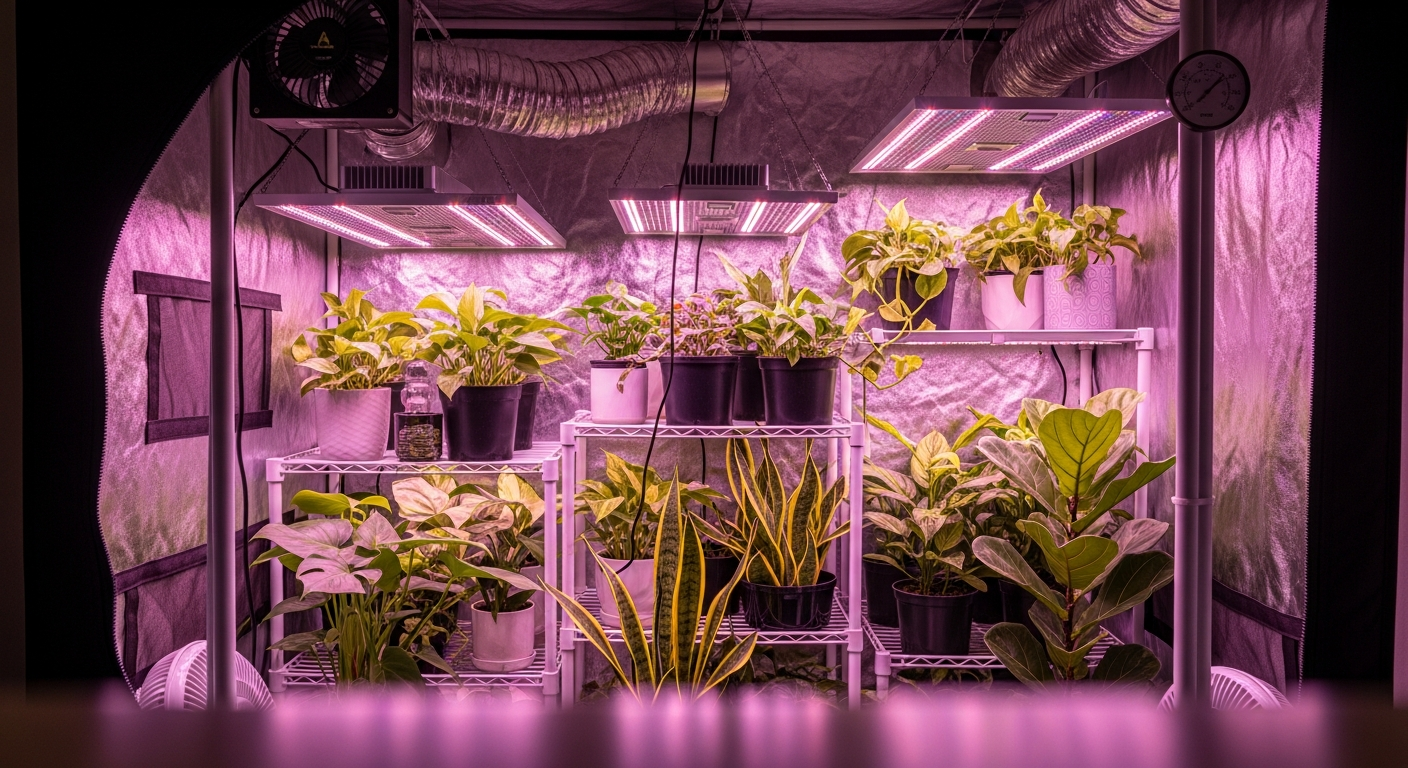
Using Grow Lights for Tomatoes: Complete Indoor Growing Guide (2026)
Tomatoes are the most light-hungry crop you can grow indoors. They need 600–1,000 µmol/m²/s PPFD at canopy for 14–18 hours per day during vegetative growth and 12–14 hours per day during fruiting. A Gorilla Xi330 (330W) covers a 3x3 tent and a Xi420 (420W) covers a 4x4 tent — both deliver enough intensity to ripen cherry and beefsteak tomatoes indoors year-round.
A windowsill never provides enough light to fruit tomatoes. A proper full-spectrum LED does in 70–140 days from seed to ripe harvest.
Growing tomatoes indoors with grow lights gives you vine-ripened flavor year-round — no mealy supermarket tomatoes in January, no blight in August, no frost worry in October. But tomatoes are demanding: they need more light intensity than any other common indoor crop. This guide covers exactly how much light your tomatoes need, which LED to pick for your tent size, how to transition from seedling to fruit, and the five most common mistakes that lead to flowers that never set fruit.
On This Page
- Why Tomatoes Need So Much Light
- PPFD & DLI Targets by Stage
- Which LED for Which Tent Size
- Tomato Growth Stages Indoors
- Best Varieties for Indoor Growing
- Complete Indoor Tomato Setup
- Indoor Pollination (No Bees Needed)
- Feeding Schedule: Seedling to Fruit
- 5 Common Mistakes & Fixes
- Frequently Asked Questions
Why Tomatoes Need So Much Light
Outdoor tomatoes receive 2,000 µmol/m²/s PPFD at solar noon in midsummer — that is 3–5× what most houseplants need. They evolved in the highlands of Peru and Ecuador under intense equatorial sun. When you bring them indoors, every photon counts.
Tomatoes need high light for two critical processes: photosynthesis during vegetative growth (building the structural plant that can support fruit) and fruit set during flowering (the plant aborts flowers when light is insufficient). A tomato plant that stretches and stays pale under weak light will flower but never set fruit — the most common indoor disappointment.
PPFD & DLI Targets by Growth Stage
| Stage | PPFD Target | DLI Target | Photoperiod | Duration |
|---|---|---|---|---|
| Seedling (germination to 3rd true leaf) | 200–400 µmol/m²/s | 10–18 mol/m²/day | 16–18 hrs | 3–4 weeks |
| Young vegetative (4th leaf to pre-flower) | 400–600 µmol/m²/s | 25–40 mol/m²/day | 16–18 hrs | 3–4 weeks |
| Mature vegetative / early flower | 600–800 µmol/m²/s | 35–50 mol/m²/day | 14–16 hrs | 2–3 weeks |
| Fruiting (active fruit set to harvest) | 800–1,000 µmol/m²/s | 40–55 mol/m²/day | 12–14 hrs | 6–12 weeks |
Tomatoes are "day-neutral" plants — they flower regardless of photoperiod length. But reducing to 12–14 hours during fruiting concentrates available light into a shorter window at higher intensity and gives the plant a longer dark recovery period, which improves sugar accumulation in fruit. This mirrors natural late-summer conditions when day length shortens.
Which LED for Which Tent Size
Tomatoes need more wattage per square foot than leafy greens or herbs. Use this table to match your tent to the right Xi-Series LED. See the LED distance chart for exact hang heights by stage.
| Tent Size | Recommended LED | PPFD at 12" | Coverage |
|---|---|---|---|
| 2x2 / 2x4 (seedlings only) | Xi220 ($495) | 600+ µmol/m²/s | Fine for seedling-to-transplant, too weak for fruiting in 4x4 |
| 3x3 (1–4 plants, fruit) | Xi330 ($595) | 800+ µmol/m²/s | Ripens cherry and determinate varieties in 3x3 |
| 4x4 (4–6 plants, fruit) | Xi420 ($695) | 1,000+ µmol/m²/s | Full fruiting intensity across 4x4 — beefsteak and heirloom capable |
| 5x5+ (production, 6–9 plants) | Xi750 ($995) | 1,200+ µmol/m²/s | Commercial-grade, pair with CO₂ for max yield |
Tomato Growth Stages Indoors
Germination
Sow seeds ¼" deep in moist seed-starting mix. Soil temp 75–80°F (use a heat mat). LED at 24" above soil, dimmed to 30%. Seeds crack in 5–10 days.
Seedling Stage
First true leaves emerge. Remove heat mat. Raise LED to 50–60% dim, 18–20" above canopy. Water when top inch of soil dries. Begin half-strength Lotus Grow Pro at 3rd true leaf. See leggy seedlings guide if stems stretch.
Vegetative Growth
Rapid stem and leaf development. Transplant into 3–5 gallon fabric grow bags. LED at 80–100%, 14–18" above canopy. Support stems with stakes or cages. Prune suckers on indeterminate varieties to keep 1–2 main stems.
Flowering
Yellow flowers appear at branch nodes. Reduce photoperiod to 14 hours. Hand-pollinate by gently shaking stems or using an electric toothbrush on flower clusters. Maintain 70–85°F during the day, 60–70°F at night — pollination fails above 90°F or below 55°F.
Fruiting & Harvest
Green fruit appears 5–7 days after successful pollination. Cherry tomatoes ripen in 6–8 weeks from flower; beefsteak in 8–12 weeks. Harvest when color is uniform and fruit detaches with a gentle twist. Indeterminate varieties keep producing for 6+ months.
Best Tomato Varieties for Indoor Growing
| Type | Variety | Days to Harvest | Best Tent Size | Notes |
|---|---|---|---|---|
| Cherry (determinate) | Tiny Tim, Micro Tom | 55–65 days | 2x2 / 2x4 | Compact, under 12", perfect for small tents |
| Cherry (indeterminate) | Sun Gold, Sweet Million | 65–75 days | 3x3 / 4x4 | Prolific, sweet — needs trellis or cage |
| Roma / Paste | San Marzano, Roma VF | 75–85 days | 4x4 | Meaty, low moisture — great for sauce |
| Beefsteak | Big Beef, Better Boy | 80–100 days | 4x4 / 5x5 | Large fruit — needs Xi420+ for intensity |
| Heirloom | Cherokee Purple, Brandywine | 80–100 days | 4x4 / 5x5 | Full flavor, longer maturity, needs support |
Determinate tomatoes grow to a fixed height, set fruit all at once, and stop. Great for small spaces and single harvests. Indeterminate tomatoes keep growing and producing indefinitely under proper light — one Sun Gold plant in a 4x4 tent can yield fruit for 6–12 months.
Complete Indoor Tomato Setup
Indoor Pollination: No Bees Needed
Tomatoes are self-pollinating — each flower has both male and female parts. Outdoors, wind and bees vibrate the flower enough to release pollen. Indoors you need to replicate that vibration.
- Gentle shaking: Tap the main stem or shake flower clusters lightly once a day. Simple and effective.
- Electric toothbrush: Touch the vibrating head to the base of each flower cluster for 2–3 seconds. The gold standard for indoor pollination.
- Fan vibration: A smart inline duct fan on oscillation mode creates enough airflow to assist pollination in dense canopies.
Pollen becomes sterile above 90°F and below 55°F. If your tent is running hot from a high-power LED, dim to 80% or increase exhaust. Monitor with a WiFi sensor — one hour above 90°F can ruin a week's flowers.
Feeding Schedule: Seedling to Fruit
| Stage | Nutrient | Dose | pH Target |
|---|---|---|---|
| Seedling (weeks 1–3) | Plain water only | — | 6.2–6.5 |
| Vegetative (weeks 3–6) | Lotus Grow Pro | 1 tsp/gal, every 2nd watering | 6.0–6.5 |
| Transition (first flowers) | Grow Pro + Bloom Pro | ½ tsp each/gal | 6.0–6.5 |
| Fruiting (active fruit set) | Bloom Pro + Cal-Mag | 1 tsp Bloom + ½ tsp Cal-Mag/gal | 6.0–6.5 |
| Throughout | pH Down | As needed to hit target pH | 6.0–6.5 |
The #1 fruiting problem indoors. Caused by calcium deficiency during rapid fruit development — usually from inconsistent watering, not actual low calcium. Keep watering steady and add Cal-Mag during fruiting.
5 Common Mistakes Growing Tomatoes Indoors
| Mistake | Result | Fix |
|---|---|---|
| LED too weak for fruiting | Flowers drop without setting fruit | Need 600+ µmol/m²/s at canopy — Xi330 or Xi420 |
| Never hand-pollinating | Flowers bloom and fall off | Shake stems or use electric toothbrush daily during flowering |
| Temp above 90°F during flowering | Pollen sterilizes, no fruit set | Dim LED to 80% or boost exhaust; monitor with sensor |
| Ignoring calcium during fruiting | Blossom end rot (black bottoms) | Add Cal-Mag to every fruiting-stage feeding |
| No support for indeterminate vines | Stems snap under fruit weight | Install trellis netting or tomato cages from week 4 |
Frequently Asked Questions
Can you grow tomatoes indoors with grow lights?
Yes — tomatoes grow and fruit fully indoors under a full-spectrum LED delivering 600–1,000 µmol/m²/s PPFD at canopy. Cherry varieties are ready in 70–90 days from seed; beefsteak varieties take 100–140 days.
What kind of grow light is best for tomatoes?
A high-output full-spectrum LED with at least 330W actual wall draw for a 3x3 tent, or 420W for a 4x4. The Gorilla Xi330 and Xi420 are purpose-built for fruiting intensity with app-dimmable tri-channel spectrum.
How many hours of light do indoor tomatoes need?
16–18 hours during vegetative growth, dropping to 12–14 hours during fruiting. Day-neutral tomatoes flower regardless of photoperiod, but shorter days during fruiting improve sugar accumulation.
How far should a grow light be from tomato plants?
18–24 inches for seedlings, 14–18 inches for vegetative plants, 12–16 inches for fruiting plants at full LED power. See our LED distance chart for model-specific heights.
Why do my indoor tomato flowers drop without fruiting?
Three causes: (1) no pollination — shake stems or use a toothbrush daily, (2) temperature above 90°F sterilizing pollen, (3) insufficient light — need 600+ µmol/m²/s PPFD at canopy.
What is the fastest tomato to grow indoors?
Micro Tom and Tiny Tim cherry varieties fruit in 55–65 days from seed under a proper LED. They stay under 12 inches tall and fit in a 2x2 tent.
What size grow tent for indoor tomatoes?
A 3x3 for 1–4 plants (cherry or determinate), a 4x4 or 5x5 for 4–9 plants (any variety). Gorilla Pro tents with height-adjustable extension kits give 8–9 feet of vertical clearance for tall indeterminate vines.
Do indoor tomatoes need fertilizer?
Yes. Start with a vegetative formula (Lotus Grow Pro) at week 3, switch to a bloom formula (Lotus Bloom Pro) when flowers appear, and add Cal-Mag during fruiting to prevent blossom end rot.
Can I grow tomatoes hydroponically indoors?
Yes — tomatoes do well in DWC or ebb-and-flow systems. Hydroponic tomatoes grow 20–30% faster and produce cleaner fruit. A DWC system inside a 4x4 tent handles 4–6 plants.
How do I prevent leggy tomato seedlings?
Use a full-spectrum LED at 18–24 inches from seedling tops, 14–16 hours per day. If seedlings stretch, lower the light or raise dimmer to 60%. Full guide: leggy seedlings fix.
Related Guides
Keep learning: Grow Light Distance Chart · Leggy Seedlings Fix · Grow Lights for Seedlings · VPD Chart · Indoor Herb Garden · How Long Do Plants Take to Grow
Grow Tomatoes Year-Round — No Garden Required
A Gorilla Grow Tent plus an Xi-Series LED delivers the intensity tomatoes need to set and ripen fruit in any season.